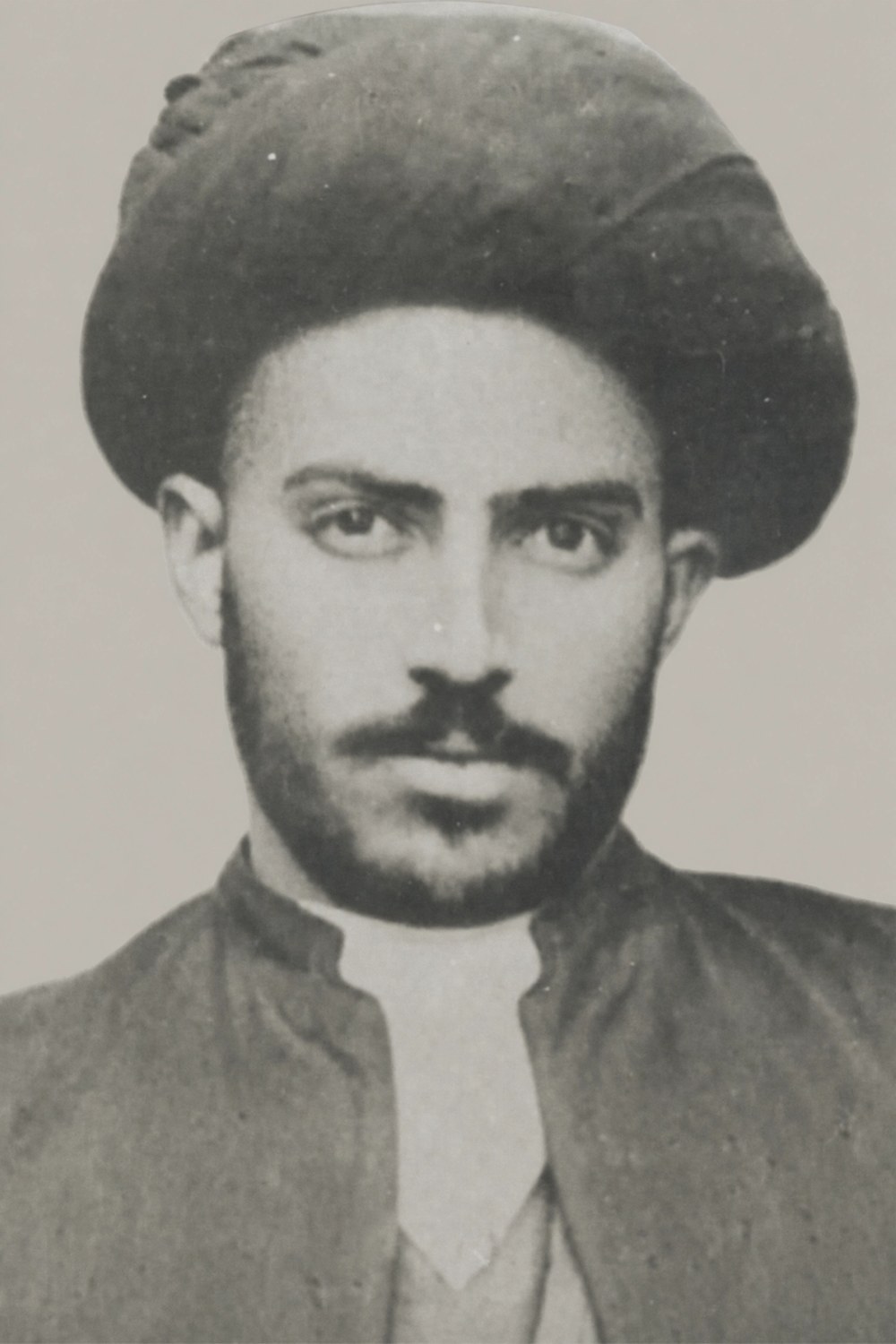
To anyone familiar with Isfahan weaving, Emami is a name met early and understood late. Beyond the carpet world he is a painter: catalogued as a miniaturist, exhibited abroad among the masters of the form, and remembered as the teacher of Mahmoud Farshchian and the man who rescued a dying leather art. The carpet sits a little behind all of that, even though his cartoons went to the first looms of the Isfahan revival. What follows is not an introduction but an account of how his name lived on the cartoon and was lost in the weave.
The Dynasty
Emami did not come to his Safavid eye alone. He was born in Isfahan in 1881, into a line of court painters of the Emami sadat (a family of sayyid descent). His grandfather, Mirza Nasrollah Emami, held the title naqqash-bashi (chief court painter) under Naser al-Din Shah. His father, Seyed Mohammad Hossein, was a painter of gol-o-morgh (flower and bird) whose lacquer work is among the finest of late Qajar Isfahan. The lineage is sometimes traced further back, to a Safavid calligrapher of the same house whose inscriptions are said to survive in the shrine at Mashhad. What is certain is that Emami was the inheriting generation of a painting family, and that the material he inherited was Safavid.
He trained first as a cleric, studying religious sciences into his early twenties, and only then turned fully to the family art. He learned painting under his father and uncle, and spent a period in Tehran studying tazhib (illumination) at the Majma’-ol-Sanaye under Mirza Razi Sani’ Homayoun. The turn that shaped him, recorded by the historian Jalal al-Din Homai, came as a young and unknown man: commissioned to trace and copy the Safavid paintings of the Ali Qapu palace, panel by panel. He said afterward that the surviving Safavid buildings of Isfahan were his greatest teacher.
The Tableau
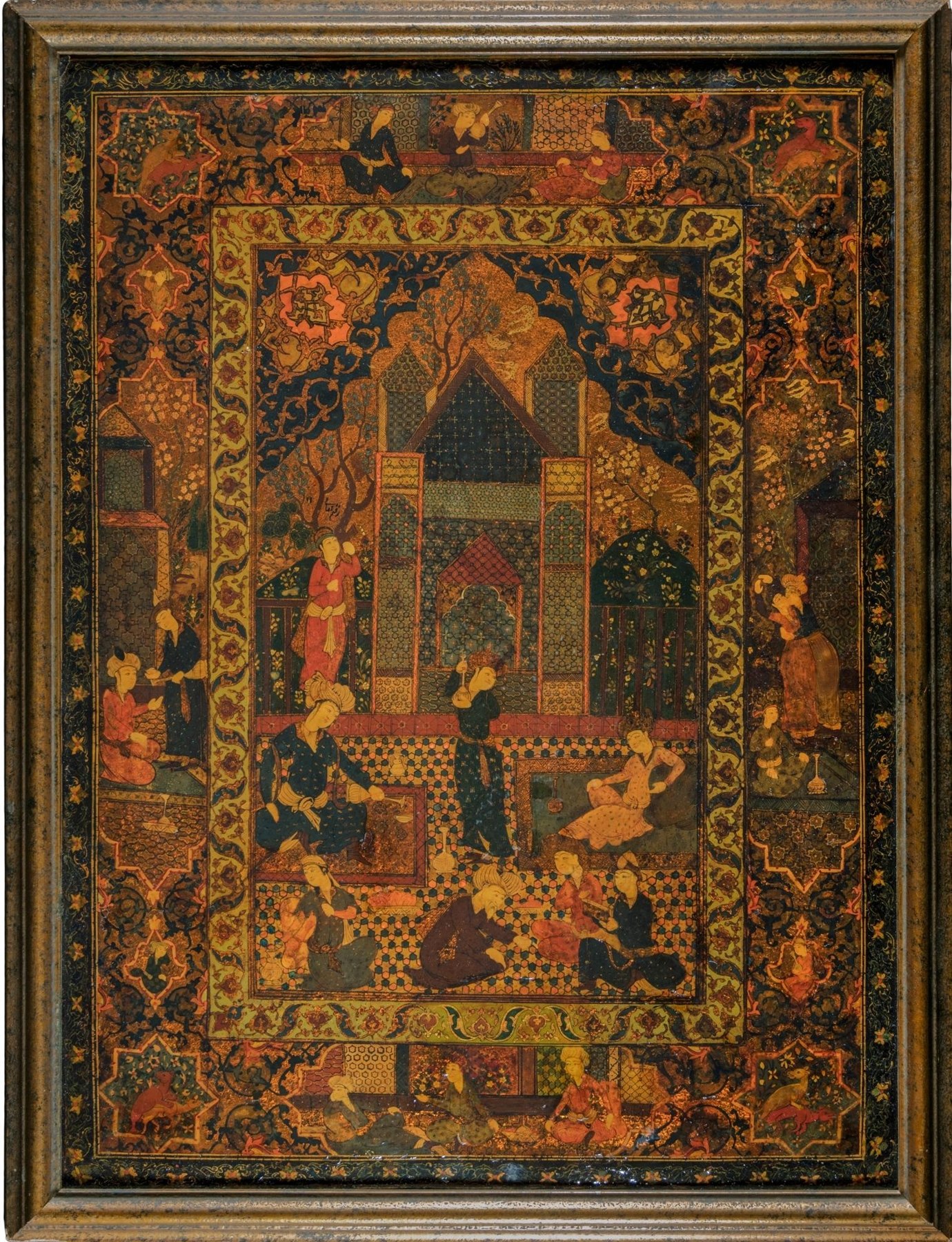
His best-known achievement in the wider art world is sukht (pyrography on leather), and the usual word for what he did to it is "revived." The word is too modest. Sukht began as a binding craft, a way of burning pictorial images into the leather covers of fine books, and by the late Qajar period cheap painted-lacquer covers had pushed it to the edge of extinction. Emami’s decisive act was not to preserve the old format but to leave it: he took the burned image off the cover and set it in a frame, as an independent picture. He was the decisive figure in carrying sukht out of the bookbinding format and onto the wall, and his hand is the one the move is dated to. The scholarship on it is recent and Iranian, and is cited below.
This matters to the carpets. He had taken a Safavid technique and moved it into a new format without losing its character. A carpet cartoon asks for a similar move: a deep training in older tradition, brought into the working vocabulary of the contemporary loom. The painter who had traced and copied the Ali Qapu walls came to the cartoon already fluent in its language. He came at the right moment: the Isfahan looms were being rebuilt after their long Qajar decline.
The Cartoon and the Carpet
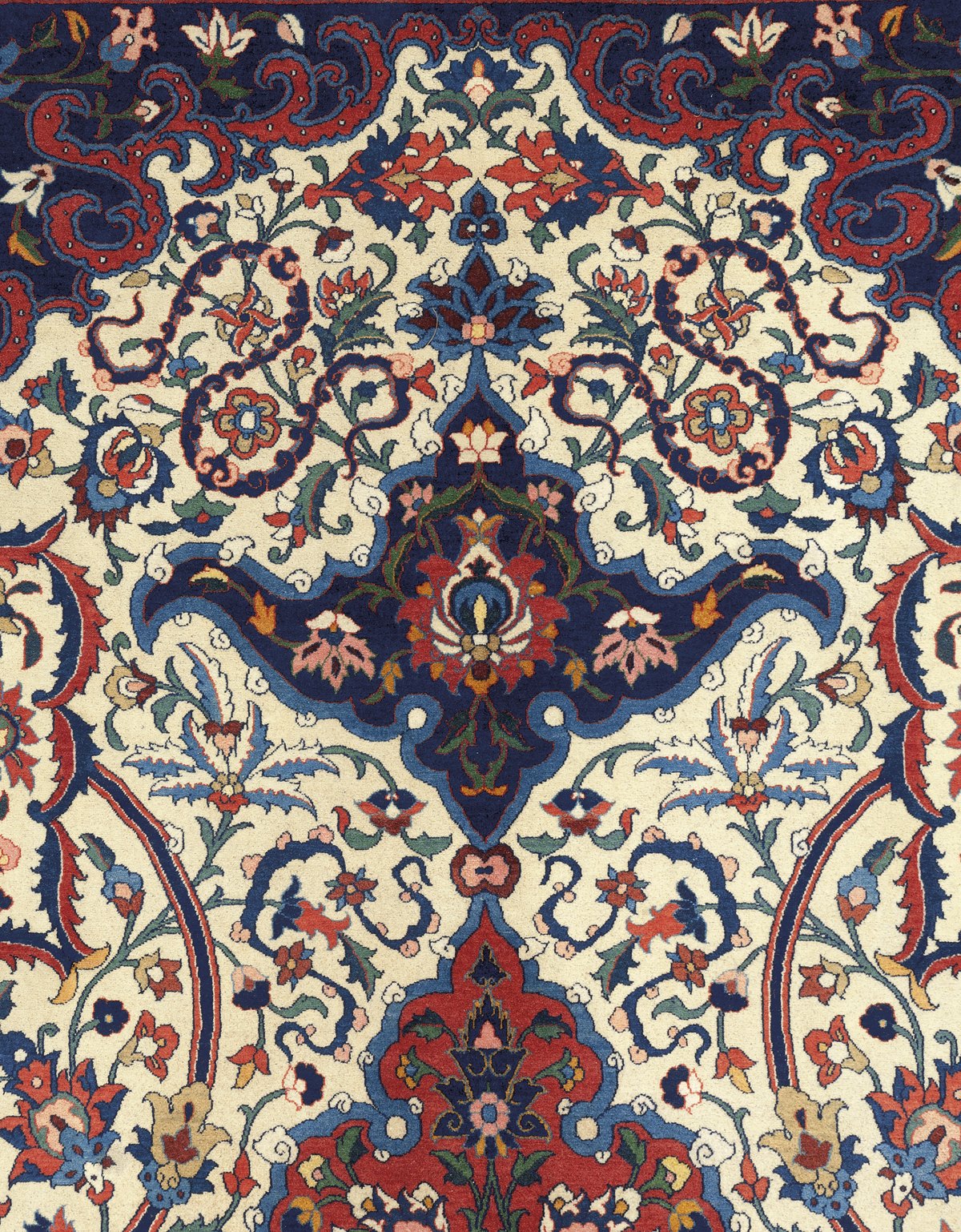
Emami was, before all else, a naqsheh-kesh (the designer). In the division of labour that built fine Isfahan weaving, the master painter draws the cartoon and a master weaver knots it; the two are different people, and a carpet carries both whether or not it says so. His cartoons were brought to life by the great producers of the day. The Iran Carpet Museum’s record for a 1920s Isfahan lachak-toranj (inv. 1762) gives the designer as "probably" Emami and the weaver as "probably" AbdolRahim Shureshi. A surviving small carpet is documented as woven in the Shureshi workshop from an Emami design; another pairing places his cartoon on the loom of Haj Mehdi Haghighi. A silk-foundation Isfahan circa 1930, sold at Christie’s London in October 2018, carried a catalogue note attributing its cartoon to Emami. The knot count, around 120 to the square centimetre, was high for the period, suggesting a top-tier production.
But he did not only supply designs to others. Carpets were also made under his own name, at his own establishment, and this is where the wider literature tends to lose him. The claim, repeated in family accounts, that he kept a hundred and thirty looms is better understood as a designer supplying many looms across many houses than as one man running a factory, and the smaller reading is the one the evidence supports. His own production was a smaller thing, and a separable one, and how it is separated is the subject of a later section.
The Name That Stayed on the Paper
He did not sign his carpets. There is no woven Emami in the border, no cartouche with his name; the carpet that came off the loom carried nothing to say whose design it was. His painting house had a mark of its own — a label reading naqqash-khaneh-ye Mirza Agha Emami, the Painting House of Mirza Agha Emami — but a painting house marks paintings, and it was an atelier’s mark — it is not claimed here as a woven signature in any carpet. By the time a design of his had become a carpet, in the hands of Shureshi or Haghighi, the weave said nothing of him.
This is the reverse of how the trade usually remembers a name. The great foreign firms announced themselves on the carpet itself, the PETAG mark woven into the pile, the Ziegler name on the ledger if not the field; the carpet carried the maker. An Emami-designed carpet carries the opposite: a first-rank object whose author is invisible in it, because the author was the designer and the design does not survive as a signature into the weave. The attribution question that runs through the houses of Isfahan is, in his case, a question the carpet cannot answer about itself. It has to be answered from outside — from the drawing, where his hand is, or from the weave, where his habits are.
How to Know One
That separation is the whole of the matter here. A carpet may bear an Emami design yet have been woven by another house on that house’s own foundation; a silk-founded Isfahan of the first rank may rest on a drawing of his, as the saleroom has shown. His own production is the narrower body, and it is the one the following describes.
Since the carpet carries no name of its own, an Emami-produced piece has to be read in a way the published sources do not reach. Among those who have handled his weaving, it is known by a few things that hold together as a test.
The foundation comes first. His own carpets are laid on a cotton warp, not silk. Then colour. The ground is most often a straw-cream, a golden, wheaten tone, and the larger the carpet the more reliably so; a lacquer-red ground appears only rarely, and lacquer-red and a deep navy are mostly kept for the borders. Then proportion. The great part of his output falls into three sizes, each a loom-width at one consistent fineness: a qālicheh (small carpet) near a hundred and seventy centimetres wide, a two-by-three near two hundred and ten, and a three-by-four near three hundred and twenty, the largest approaching fourteen square metres. Read as widths at a single fineness, the three are one decision repeated.
These describe his own production as it is known to those who have handled it. They are a test, not a census; a genuine piece may sit outside them, but one that fails all three is unlikely to have left his house.
The Inheritance
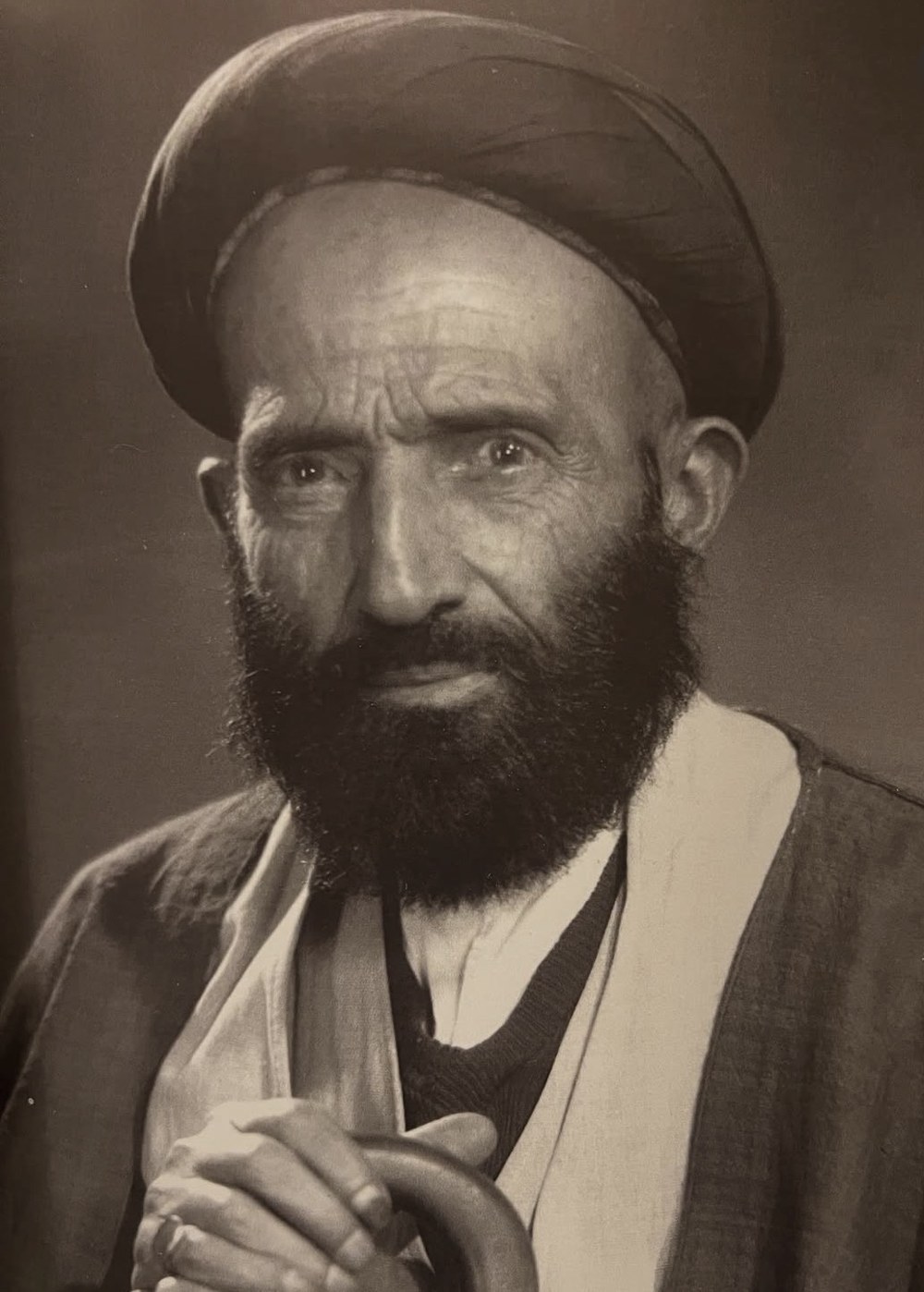
Emami died in Isfahan in 1955, in his mid-seventies, and was buried at Takht-e Foulad. When the first serious study of him was made, only a handful of pages and a few museum pieces were known; the rest had to be found.
His students carried his eye forward, Farshchian the most celebrated among them; that the man who reshaped Persian miniature for the twentieth century learned his first grammar in Emami’s workshop is the measure of the eye, and a reminder that the carpet was only ever one of the places it went. But the quieter inheritance is on the loom. The carpets drawn from his cartoons, and the carpets made under his own direction, are still in rooms and collections, none of them signed, recognisable only to those who know the cotton warp, the straw-cream ground, the three widths. They are the work of a painter who gave the loom a Safavid eye, and who left no name in any of them.
Sources
- Mehdi Vafamehr and Nasser Emamifar, on the invention of the standalone sukht tableau and Emami’s role in it, Negareh, no. 6 (2008); reported in Fars News Agency and Mehr News Agency in coverage of the May 2025 exhibition of an Emami sukht work at the Iran Decorative Arts Museum.
- Mehdi Vafamehr, The Life and Artistic Works of Haj Mirza Agha Emami (monograph, awarded at the 2012 Book of the Season), as reported by the Iran Book News Agency, for the scarcity of surviving documentation and the 1881–1955 life span.
- Persian Wikipedia, "میرزا آقا امامی," for the lineage, training, and the painted doors recorded in the Victoria and Albert Museum and the Metropolitan Museum of Art, attributed there and noted here as such.
- Jalal al-Din Homai, Tarikh-e Esfahan, as reproduced in Persian biographical sources, for the Ali Qapu commission and the burial at Takht-e Foulad.
- Iran Carpet Museum, Tehran, object record (shenasnameh) for inv. no. 1762, a circa-1300 SH / 1921 Isfahan lachak-toranj (cotton warp, wool pile, 65 raj), giving the designer as “probably” Emami and the weaver as “probably” AbdolRahim Shureshi — the museum’s own qualified language, published on its official Instagram account, 5 October 2021. The weaver attribution has been publicly questioned; the hedge and the open question are carried into the article as such.
- A circa-1930 silk-foundation Isfahan carpet sold at Christie’s London in October 2018, whose catalogue attributes the cartoon to Mirza Agha Emami, for the continuing attribution of his designs at auction.
- Mehr News Agency, for the independent confirmation of Farshchian’s apprenticeship.
The naqqash-khaneh label, the 1881–1955 life span, the “hundred and thirty looms” figure and the deeper Safavid lineage are family-sourced — from the archive published by Emami’s descendants and the monograph’s author — and are attributed as such in the text; the label is recorded by the family as a mark used on his works, and is not claimed here as a woven mark. The account of Emami’s own production — foundation, palette, and the three sizes — is primary research by Gereh & Naqsh, gathered from those with direct knowledge of the work; the translations and the reading of the Persian sources are the house’s own.