
The story usually told about the Persian carpet in the nineteenth century is that Europe found it, organised it, and saved it from decline. It is a flattering story, and it is largely backwards. The export industry that carried Persian carpets into the drawing rooms of London and New York was first organised by Persian merchants, in Tabriz and Kerman, working in their own cities and on their own account. The foreign houses came to scale up a trade the locals had already built. What they brought was capital, organisation, and a sharp eye for Western taste. What they left behind is more complicated, and more interesting, than either their admirers or their critics allow.
This is the history of those firms: who they were, what they made, and what they cost. The aim here is only to set down, as plainly as the record allows, what the foreign houses did to the Persian carpet between the 1870s and the Second World War.
The boom, and who started it
By the 1870s the Persian carpet had become a Western appetite. The international exhibitions of the period did much to feed it: the Vienna World’s Fair of 1873, where Persia showed carpets and silks to a vast European public, and then the landmark exhibition devoted to oriental carpets held in Vienna in 1891 and echoed in London the following year. Cheaper shipping after the opening of the Suez Canal and a falling silver price brought carpets within reach of more buyers. Demand soon ran ahead of supply.
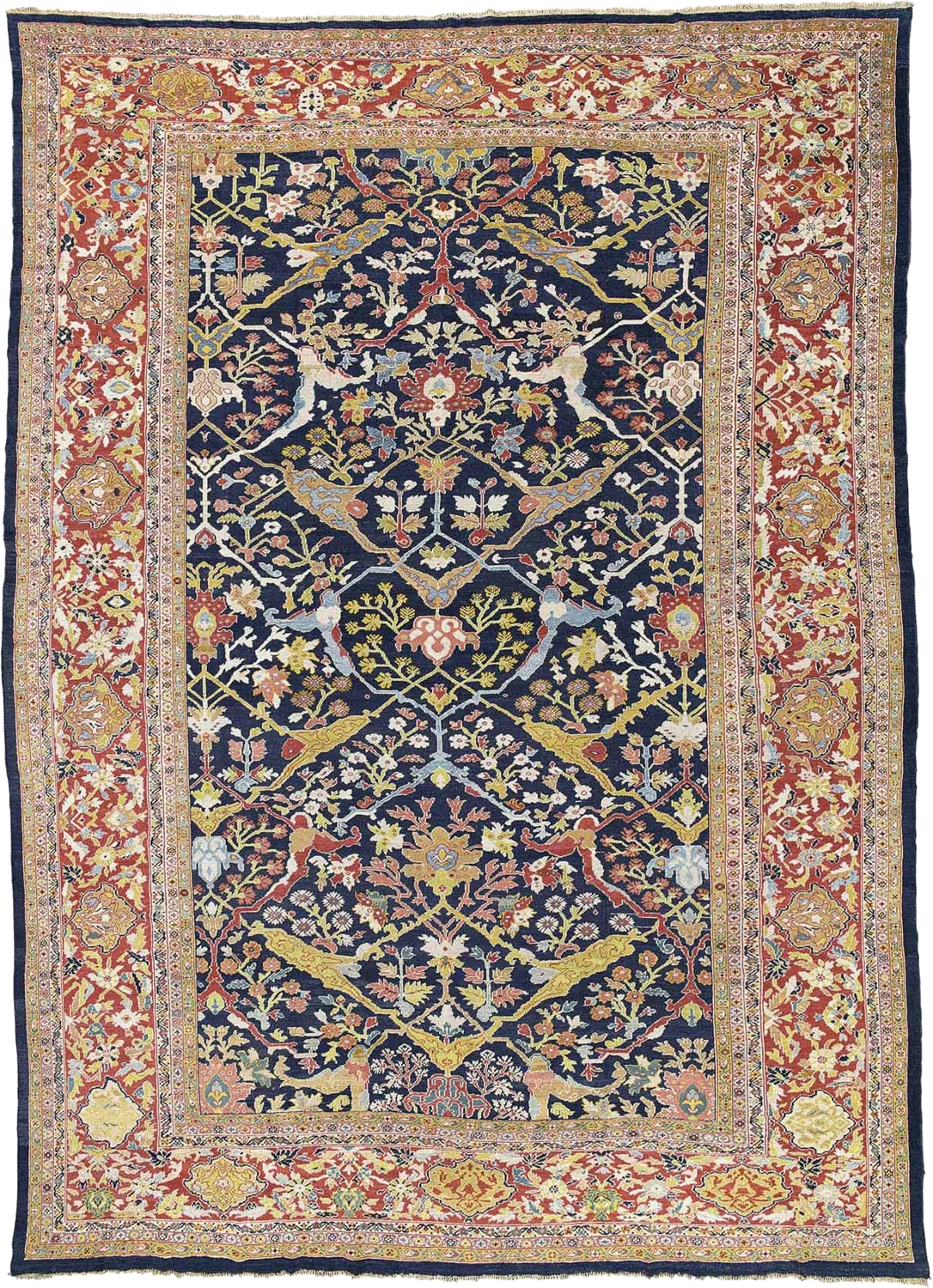
The usual account credits foreign enterprise with meeting that demand. The better-documented one complicates it. The Encyclopædia Iranica is clear that the organisation of export weaving was, in important centres, a Persian initiative before it was a foreign one. In Tabriz, local merchants arranged the contracts and reoriented an old craft toward the new market. In Kerman the case is cleaner still: Kermani merchants financed and ran the export trade through the 1890s, and the foreign firms, the two American houses, did not arrive until 1909, after the local industry was already established. Ziegler was earlier, and is the genuine foreign pioneer of organised manufacture. But even it built on existing village weaving rather than conjuring an industry from nothing. The foreigners scaled, standardised, and reoriented. They did not invent.
Ziegler, and the firm that bought carpets to move money
The pioneer was an accident of accounting. Ziegler & Co. was an Anglo-Swiss house in Manchester, in the business of selling printed cotton goods into Persia. Their difficulty was getting the proceeds home: money earned in Persia was hard to remit to London. One of their men, a German named Strauss, proposed a solution. Spend the trapped funds on carpets, ship the carpets to England, and sell them there. The plan was adopted, and around the early 1880s Ziegler became a carpet manufacturer almost by side effect. (Some accounts place the firm’s first carpet activity a little earlier, around 1876.)
What followed was the first industrial-scale carpet operation in Iran organised on foreign capital. At Sultanabad, modern Arak, Ziegler built a walled compound the locals called the Ziegler Fort, with offices, stores, stables, gardens, and its own dye-house. The dye-house mattered: by controlling the dyeing, Ziegler controlled colour, and the firm’s defenders made much of the fact that its yellows were fast and its palette stable. The scale of the thing was remarkable. By 1906 the firm’s manager, Franz Theodor Strauss, could write that he had a hundred and eleven villages under his command, with the loom count across the district running, by various estimates, into the thousands.
Ziegler wove for the West, and shaped its carpets to suit it: large in scale, soft and open in design. But the firm was not the philistine of legend. It supplied weavers with small sample rugs to work from, kept its own dyeing in hand, and is reported to have refused orders whose designs were not sufficiently Persian. One account holds that its largest single commission was a copy of the celebrated Ardabil carpet for an American client. The firm’s name is also linked, through its manager Strauss, to the discovery and sale of the original Ardabils, though that connection rests on a single family account.
The end, when it came, was a matter of currency rather than taste. In 1934, with sterling and the dollar off the gold standard and a new Iranian law forcing exporters to surrender their foreign earnings at an artificial rate, the firm could no longer turn its Persian sales into money it could keep. Ziegler closed its carpet business and withdrew, after some seventy-five years in the country.
OCM, the colossus, and the authority who liked synthetic dye
If Ziegler was the pioneer, the Oriental Carpet Manufacturers was the giant. Founded in 1907 from a group of Levantine merchant families in Smyrna (the modern port city of İzmir, Turkey), together with an English partner, and registered in London, OCM set out to control every stage of production, from the washing of the wool to the cartoons handed to the weavers, and within a few years it dominated the carpet trade of Ottoman Turkey. In 1911 it turned to Persia, building its operation around the city of Hamadan.
The firm’s most famous servant was Arthur Cecil Edwards, who ran OCM in its later decades and, in 1953, wrote The Persian Carpet, still the standard English survey of the subject. It is worth knowing, then, that Edwards was no purist about dyes. He accepted a place for synthetic dyes when they were well made and well applied, and he defended the chemical washing of carpets to soften their colours for Western eyes, a pragmatism at odds with the natural-dye orthodoxy of later collecting. The author of the canonical book, in other words, was a working carpet man before he was a connoisseur. OCM’s later history runs in the same practical grain: after the war the firm developed a proprietary “Gold Wash” that recoloured Afghan carpets for the market, and dealt in artificially aged rugs, once dubbed the arrival of the adulterated carpet. OCM is also reported to have woven its name into a small number of its carpets, particularly Kerman examples, though the practice was not universal and the surviving evidence is limited.
PETAG, and the firm that marked its work
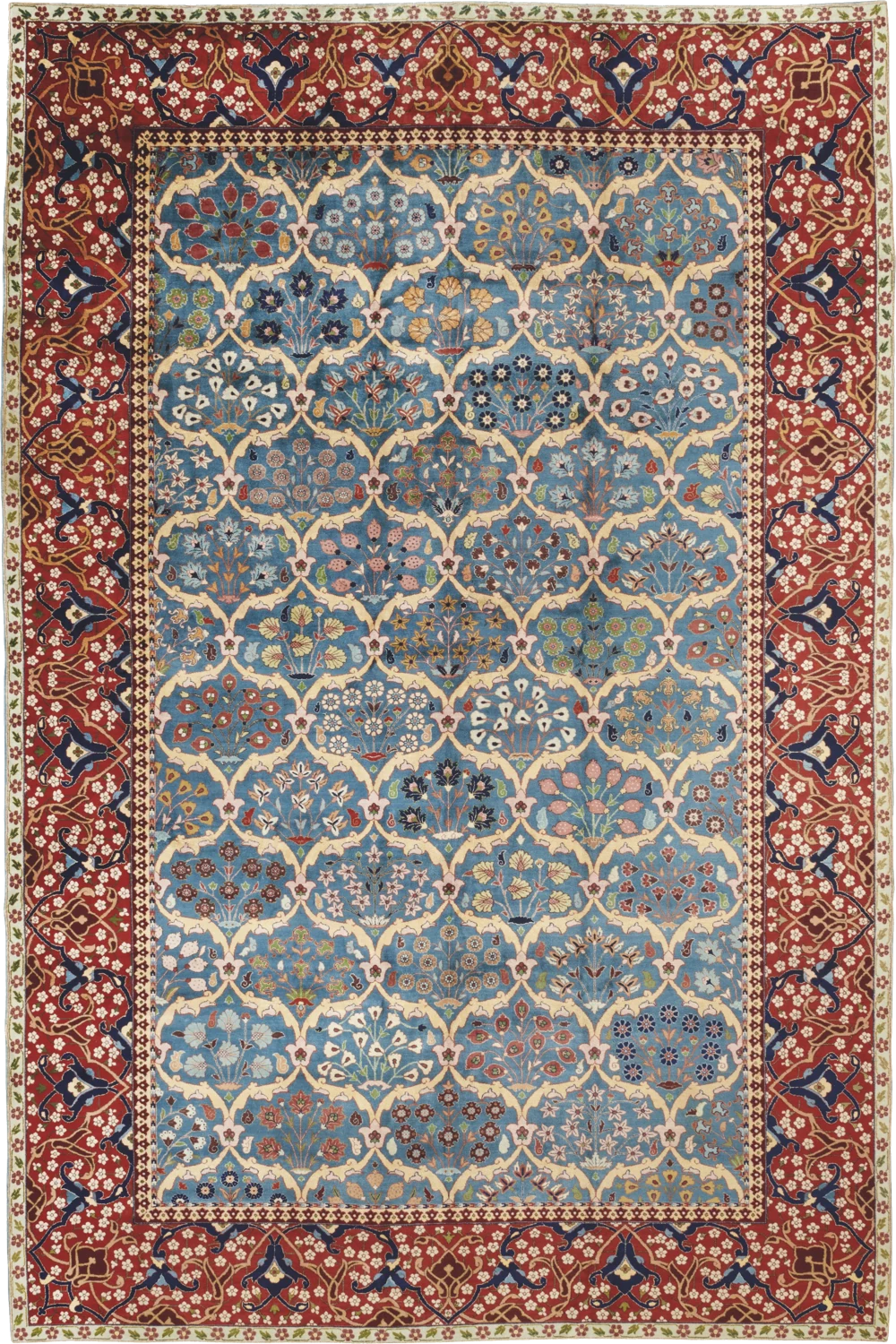
Against this current ran one firm in the opposite direction. The Persische Teppich-Gesellschaft, PETAG, was founded in Berlin in 1911 by the scholar-dealer Heinrich Jacoby, and presented itself as a corrective to the commercial degradation of the trade: a company that would compete on quality rather than volume, reviving the great designs of the sixteenth and seventeenth centuries. From a single large workshop in Tabriz, active through the 1920s and 1930s, PETAG wove faithful copies of Safavid masterpieces, the Chelsea carpet now in London, the Mantes carpet in the Louvre, the great animal carpets, working from the large colour plates published in European folios by scholars such as Sarre and Martin. It used lustrous kork (fine, soft wool) and natural dyes, and many collectors and scholars regard its output as the highest in quality of any foreign-owned carpet enterprise in Iran.
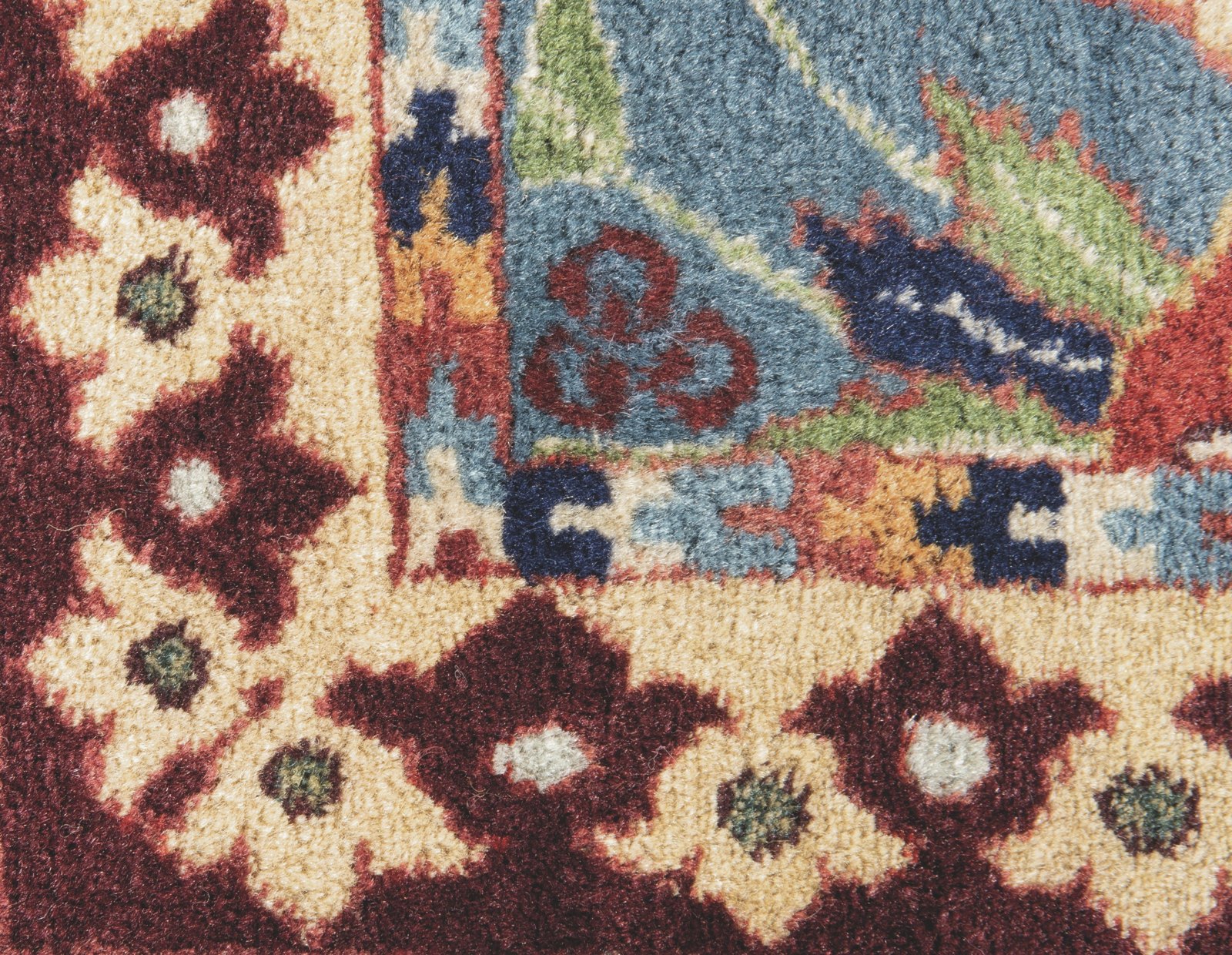
PETAG also did something the other firms did not do consistently, and it is the thing that sets its work apart: it marked its carpets, with a single recognisable device. In a corner of the field or border it wove the çintamani (three roundels in a triangle), an old Ottoman court motif that Jacoby took as the firm’s emblem. Because the mark was applied as a matter of course, a PETAG can be identified as a PETAG, which is more than can be said for most of this era’s export work. The point is not a small one. A carpet’s PETAG origin was once disputed until the carpet was examined and the three roundels were found in the corner. The mark closed a case that scholarship alone could not.
The American houses in Kerman
Two smaller firms complete the picture. Nearco Castelli & Brothers, Italian-owned despite a New York base, and the Eastern Rug & Trading Company, also of New York, began contracting weavers in Kerman in 1909, in the wave of foreign investment that followed the local merchants’ lead. They were exporters more than innovators, commissioning Kerman carpets for the American market. Castelli, at least, signed some of its work, weaving its name into the border, a detail that ties the firm to the wider Kerman trade, though the surviving documentation is thin.
Who paid for it
No honest account of this industry can leave out who did the weaving. The carpet boom rested heavily on the labour of children, some as young as five, valued for small fingers that could tie fine knots, working long hours in cramped, damp, poorly ventilated workshops, with lasting damage to their growing bodies. The existence of the problem is not in doubt: consular and missionary reports of the period describe it plainly, and British missionaries ran hospitals that treated the children the trade had injured.
The foreign firms were not bystanders to this; they were built on it, under the protection of European diplomats. After the First World War the new International Labour Organization pressed the matter, and in December 1923 the governor of Kerman issued a decree setting an eight-hour day, a minimum working age, and standards of sanitation and inspection. British reports a year later credited the improvement partly to the better firms, a generous reading, given that those same firms were part of the system the reforms were written to correct.
The quality question, fairly put
Did the foreigners ruin the Persian carpet or rescue it? The honest answer is that they did some of each, and that the question was already being argued at the time. Lord Curzon, writing in 1892, blamed Europeans for the loss of originality and the spread of cheap aniline dye. A correspondent of the Morning Post shot back a decade later that Curzon had never been to Sultanabad, that the Ziegler dye-house used no aniline at all, and that the firm turned away designs that were not properly Persian. Both men were partly right. The boom did flood the market with coarse, chemically dyed carpets whose patterns were diluted toward Western taste, with softened palettes and simplified motifs closer to European furnishing fabric than to Persian tradition. The same boom also produced PETAG’s scrupulous revivals and Ziegler’s fast-coloured Ferahans. The trade contained its own best and worst at once.
A name on no carpet
There is a last twist, and it is the one that matters most. Of all the carpets attributed to Ziegler, almost none can be proved to be Ziegler’s work. The firm wove no mark into its carpets, and the carpets it commissioned cannot be reliably told apart from the very similar export work of its competitors. The scholar who studied the firm’s own surviving design cartoons concluded that it is simply not known how Ziegler’s carpets differed in structure from the rest. A dealer who spent a career with these carpets put it more bluntly: “Ziegler” was once a useful term among knowledgeable people for a really good Sultanabad rug, but it has been overused until it means almost nothing, and new “Zieglers” are woven to this day in Pakistan and Romania.
So the word survives, attached to a quality it can no longer guarantee and a maker it can no longer prove. PETAG is the exception, for the simple reason that it left a mark to find. A name is worth only what can be verified beneath it.