In 1794, Agha Mohammad Khan’s army reduced Kerman to rubble. Ninety days of destruction erased a city that had woven some of the most complex carpets the Safavid world ever produced. What rose from those ashes was new. Drawing on the skills of shawl-makers and the vision of miniature painters, Kerman rebuilt its carpet tradition from almost nothing, then carried it further than any other city. Where Isfahan revived a classical vocabulary and Kashan translated the discipline of the tile-maker onto the loom, Kerman made the knotted pile carpet behave like a canvas. Pictorial carpets were woven across Persia, in Tabriz, Kashan, Isfahan, and among the Qashqa’i, but it was Kerman that made the genre its own: the mashaheer, the portrait carpet, rendered with a refinement no other city matched.
The Vase Technique
Kerman’s claim to weaving greatness begins in the Safavid era. During the sixteenth and seventeenth centuries, the city produced some of the most structurally complex carpets ever made in Persia. The scholar May H. Beattie identified their defining innovation: a triple-weft foundation in which the first and third wefts are thick and held under high tension, while the middle weft is thin and sinuous. This creates a stiff, deeply corrugated structure that allows for an extraordinarily dense knot count and, consequently, for the sweeping, naturalistic floral lattices and oversized palmettes that characterise the type. Beattie named the technique after the vases that appear as minor motifs in many of these carpets, though the name has since been applied to the structure itself regardless of design.
The most celebrated survivors of this era are the Sanguszko carpets, a group of fourteen known masterpieces named after the Polish aristocratic family who once owned them. According to family tradition (though the scholarly record traces it only to the family’s collection by the early seventeenth century), an ancestor seized their famous carpet from the tent of a defeated Ottoman soldier at the Battle of Khotyn in 1621. That carpet now resides in the Miho Museum in Japan, purchased in 1994 for a reported four million dollars. With their intricate hunting scenes, mythical beasts locked in combat, and lush floral lattices, the Sanguszko group represents what scholars believe to be the zenith of Safavid weaving in the south-east; though the Kerman attribution, while widely accepted, remains conjectural. A magnificent example of a related Kerman lattice carpet was owned by the British designer William Morris and is now in the Victoria and Albert Museum.
This golden age was brutally interrupted. In 1794, during the civil war that brought the Qajar dynasty to power, Agha Mohammad Khan besieged Kerman. When the city fell, it was subjected to ninety days of systematic killing; the population was massacred, blinded, or enslaved, and the city’s ancient craft infrastructure was entirely obliterated.
The Shawl and the Transition
Kerman became a city of shawls, not carpets. For much of the nineteenth century, the survivors and descendants of Kerman’s artisans wove termeh, fine wool shawls that rivalled those of Kashmir and were the city’s primary export. The transition back to carpet weaving occurred in the final quarter of the century, driven by a collapse in the global shawl market and a simultaneous surge in Western demand for Oriental carpets. The shawl weavers of Kerman adapted their skills and their designs to the knotted pile carpet; the earliest of these transitional pieces, dating to the 1880s, are characterised by the pervasive use of the boteh (paisley) motif and the cypress tree, direct borrowings from the shawl repertoire.
This revival attracted foreign capital. In 1887, Nearco Castelli, a Venetian entrepreneur, established workshops in Kerman, initiating a period of intense collaboration between European capital and local artistry. By 1909, the Eastern Rug and Trading Company of New York had invested heavily in the region, and by 1924, fourteen foreign companies maintained representatives in the city. The influx of capital transformed Kerman; as the local historian Vaziri Kermani noted, the boom was so profound that “everyone in Kerman who had ten tomans set up a loom.” By the late 1920s, the Encyclopædia Iranica records some five thousand looms operating in the city. But the defining feature of the revival was not its volume. It was its artistic ambition.
The political elite of the province played a direct role. A Christie’s-catalogued gallery carpet, dated AH 1286 (1869–70), bears an inscription identifying it as commissioned by “His Excellency Vakil al-Mulk”, the title of the successive Qajar governors of Kerman between 1859 and 1878, and woven by “Ustad Qanbar Ali Kermani, son of Ustad Aqa-yi Ghali-Baf.” The father’s name is itself a title, ghali-baf means “carpet-weaver”, confirming a hereditary craft dynasty in Kerman a full generation before the foreign firms arrived. The weaver should not be confused with the later and more famous Ostad Ali Kermani (1877–1939), also known as Ali Honari, who wove the great mashaheer carpet for Hassan Khan Shahrokhi half a century later. Whether the two men were related (Qanbar Ali active in 1870, Ali Honari born in 1877 to a father named Ali Akbar) remains an open question in the scholarship, but their shared surname reflects the common practice of Kerman’s master weavers identifying themselves simply by their city.
The Shahrokhi Dynasty
The transition from shawl to carpet required new designs, and this demand was met by a remarkable lineage of master painters. The patriarch, Mohsen Khan Shahrokhi (1829–1911), was a miniaturist who worked on papier-mâché pen cases. He is credited with inventing the “dotting technique” (noghteh-zani) that allowed miniature paintings to be translated onto point-paper for carpet weavers. His son, Hassan Khan Shahrokhi (c. 1862–1940), known in the trade as “the marvel of portraiture,” transformed the Kerman aesthetic. Also a mathematician and astronomer, he created thousands of designs over a career spanning six decades, shifting the work toward lush, naturalistic florals and, most famously, the mashaheer, the celebrity carpet.
Though pictorial carpets were woven elsewhere in Persia, none pursued the genre with Kerman’s ambition or refinement. It is a genre that has always divided connoisseurs: dismissed by some as kitsch, prized by others as the boldest thing the Persian loom ever attempted. The most celebrated example, designed by Hassan Khan and woven by the master Ostad Ali Kermani around 1920, depicts 109 Iranian kings, 56 world figures, and 16 Achaemenid and Sasanian reliefs across eighteen square metres, woven at 9,200 knots per square decimetre. It is now housed in the Niavaran Palace Museum in Tehran. According to the museum’s own records, the carpet was most likely commissioned by Abd al-Hossein Mirza Farmanfarma, the Qajar governor of Kerman, who had a deep interest in Iranian history and the political means to fund such a monumental undertaking.
The carpet is also a document of its era’s nationalism. The overwhelming majority of the kings depicted are pre-Islamic, drawn not from archaeological evidence, which was then unavailable, but from Ferdowsi’s Shahnameh, with only a small number from the Islamic period. The Niavaran Museum notes that this reflects “the fascinated gaze of Iranians toward the peak and flourishing of pre-Islamic civilization” at a time when the Pahlavi-era revival of ancient Persian identity was beginning to take shape.
A second masterpiece by the same collaboration, a narrative carpet depicting approximately 220 human and animal figures of nomadic life, woven at 12,000 knots per square decimetre, is so fine it earned the designation kaghazi, “paper carpet,” in the trade. Other master weavers, such as Aboul Ghasem Kermani (active c. 1880–1900, known as the “Master of Masters”) and Mohammad Ibn Jafar (called “the King of the Persian Carpet”), further refined the pictorial tradition, producing narrative carpets of extraordinary scope.
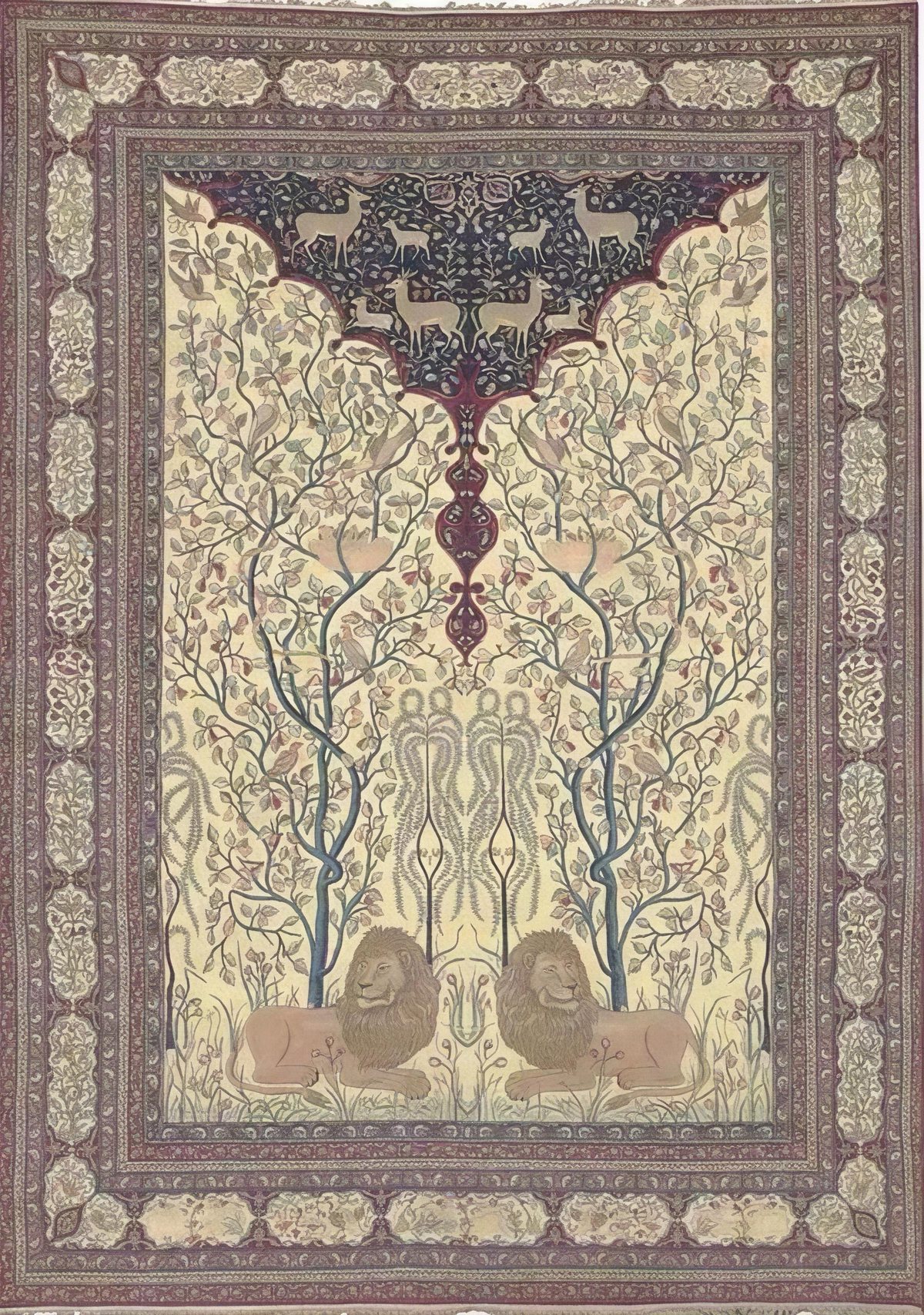
One detail illuminates the relationship between designer and weaver in Kerman more clearly than any other: the weavers of the mashaheer were typically illiterate. Many of the designs they reproduced were drawn not from life but from European source material: paintings, tapestries, and the newly circulating photographs of Persepolis, copied onto point-paper and re-woven in wool. Guided only by the cartoon, they reproduced what it showed them knot by knot, without understanding the Latin inscriptions or European names in the design. The Niavaran Museum records that the Latin text in the great mashaheer carpet is frequently misspelled: evidence that the weaver’s hand was guided entirely by the designer’s eye, and that the two roles, though inseparable in the finished piece, were worlds apart in education and social standing.
The finest of these carpets were often woven not in Kerman city itself, but in Ravar, a town some 75 kilometres to the north that became synonymous with the highest grade of Kerman production. In the West, the name is frequently corrupted to “Lavar,” a mispronunciation that has persisted in the trade for over a century. The Niavaran Palace Museum describes Ravar as “the greatest tradition-breaker of Iranian carpet”, a centre whose designers never limited themselves to established conventions, working with palettes of up to thirty colours where other cities used a fraction of that range.
The American Era
By the 1920s, Kerman’s production was overwhelmingly geared toward the United States, which absorbed some 90 percent of its output. To satisfy American tastes, the city’s designers shifted away from the dense, traditional Persian palette toward pastel tones, soft greens, pale blues, and rose pinks, set against open, unadorned fields. This period, spanning the 1920s and 1930s, is often considered the “Classic Era” of modern Kerman weaving. The wool, sourced locally and renowned for its softness and lustre, was dyed before spinning, resulting in exceptional colour uniformity. A. Cecil Edwards, the great chronicler of the Persian carpet, considered the Kerman production of this decade to be the benchmark against which all other Persian weaving should be judged.
The reliance on a single foreign market proved catastrophic during the Great Depression. The 1929 stock market crash decimated American demand, forcing many foreign firms to withdraw. The industry was eventually stabilised under Reza Shah’s Iranization policies, with the state-backed Iran Carpet Company stepping in to maintain production standards and employment. But the city never fully recovered its earlier momentum, and the introduction of the cost-cutting jofti (paired) knot in the mid-twentieth century marked the beginning of a long decline in average quality.
The Unravelling
Today, the Kerman carpet industry faces a graver long-term threat than the destruction of 1794. The reimposition of United States sanctions in 2018 severed Iran’s access to its largest market, and exports collapsed. According to the Iranian customs organisation, national carpet exports plummeted from over $400 million in 2017 to $41.7 million in the year ending March 2025, a 95 percent decline from the industry’s peak in the early 1990s, when the trade generated over two billion dollars and carpets accounted for 44 percent of Iran’s total non-oil exports. “We lost the US, the buyer of more than 70 percent of Iranian hand-woven carpets,” noted Zahra Kamani, head of Iran’s National Carpet Centre. Domestic foreign exchange repatriation policies have compounded the loss, forcing many traditional exporters to abandon the trade entirely. Two million livelihoods are estimated to depend on the industry nationwide.
In Kerman, where the loom once supported an entire provincial economy, the impact has been devastating. The legendary Iran Carpet Joint Stock Company, established in 1935 to protect the industry, was privatised in 2013 and is now listed as a major debtor by the Central Bank. As workshops close and weavers seek alternative employment, the intricate art of the mashaheer and the delicate florals of the Ravar masters risk becoming a closed chapter. The city has rebuilt its looms before: after the devastation of 1794, after the collapse of the shawl trade, after the Great Depression, each time by drawing on something other cities lacked. The first time it was the shawl-maker’s hand; the second, the miniature painter’s eye. What it draws on now, in a world that has largely stopped buying, is not yet clear.