In the early twentieth century, Qom was a desert pilgrimage city with almost no carpet industry. The great weaving centres of Tabriz, Kashan and Isfahan traced their looms back to the Safavid court and earlier. Qom had nothing of the kind. Less than a century later it produces what are widely considered among the most technically precise, colour-dense and expensive silk carpets in the world.
Its rise to the front rank of silk weaving is a modern story: migration from Kashan, commercial reinvention, and a steady push toward ever finer work. This account draws substantially on Persian-language oral testimony recorded by the Qom trade, material rarely synthesised in English.
The Kashani Migration
The Qom carpet industry was imported. In the late nineteenth and early twentieth centuries, merchants and master weavers from Kashan, a city with a deep weaving heritage, began migrating to Qom. They brought their designs, chiefly the lachak-toranj medallion-and-corner layout, together with the asymmetrical Persian knot and the capital to set up workshops.
Scholarly accounts date organised carpet production in Qom to the 1920s. The city had what the older centres did not need to build: a strong merchant class, plentiful labour, and the advantage of sitting close to Tehran. Much of its early output was silk, in varied and eclectic designs that competed with Kashan’s in the Tehran market. That eclecticism, the freedom to borrow from anywhere, became the city’s signature rather than its weakness.
The groundwork was laid earlier. According to the oral history given by his grandson to the Qom Research Foundation, one of the earliest pioneers was Mirza Ali Akbar Kashizadeh, who migrated from Kashan around 1886, a generation before production took commercial shape. His pivotal contribution was teaching the local population the art of cheleh-keshi, or warping, the foundational skill without which commercial weaving cannot exist.
As the industry began to scale in the following decades, other Kashani migrants arrived to build on that foundation. Haj Mahmoud Erami, who came to Qom as a child around 1924, mastered the warping trade and became the first producer to take carpet weaving systematically out of the city and into the surrounding villages of the Khalajestan district.
These early Qom carpets were heavily influenced by Kashan. They were woven in wool, often kork (fine, soft wool), on cotton foundations, using a limited palette of five or six natural dyes.
The Silk Revolution
The Kashizadeh and Erami families built the structure of Qom weaving. Its luxury reputation belongs to one man, Ali Tajer Rashti, known as Rashtizadeh. He migrated from Kashan to Qom in 1939, and is widely credited, including by Kashan University, as the founder of Qom’s silk-carpet industry.
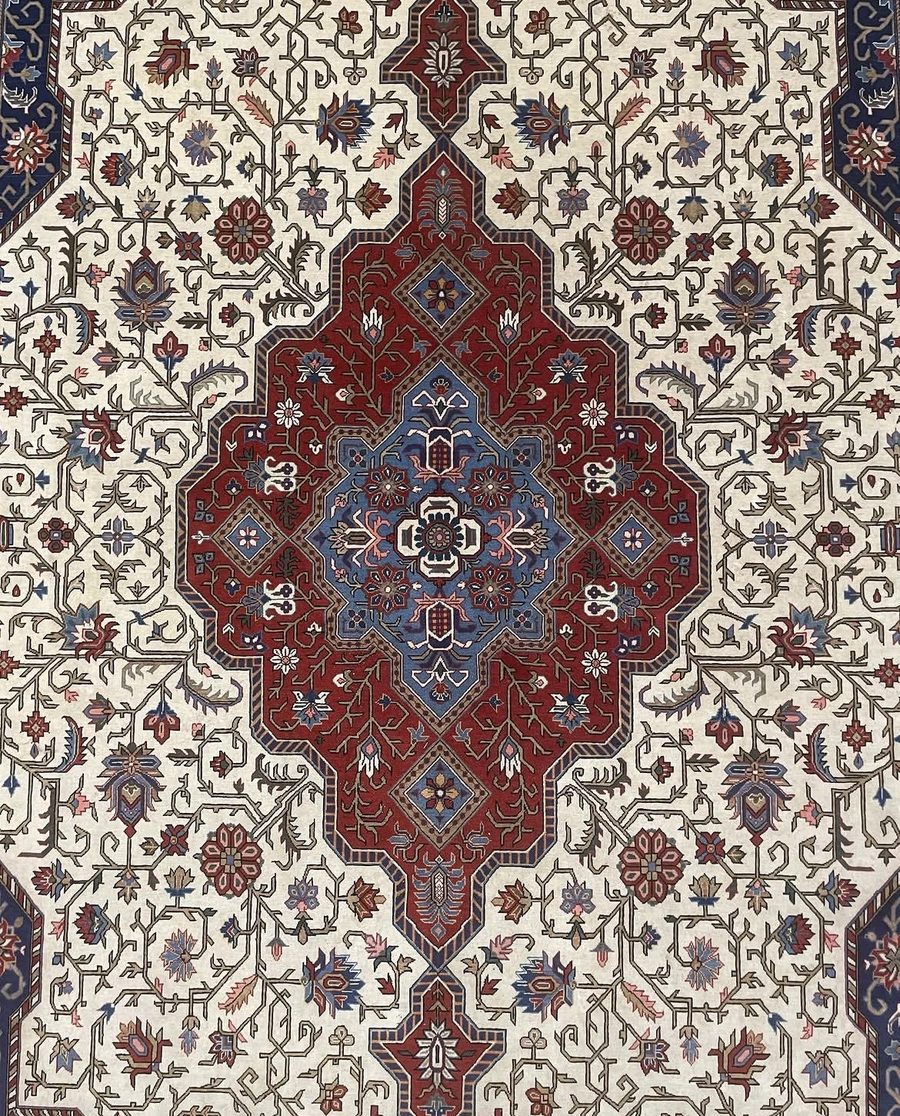
His standing was recognised early in the serious carpet press. A 1983 review in HALI, the leading English-language journal of carpets and textiles, singled out a fine silk Qom of around 1960 as among the most remarkable of Rashtizadeh’s work. Decades later, marking the carpet prize that now carries his name, HALI described him as “widely acknowledged to have been the leading carpet designer in Iran in the late 20th century.” The word designer here means artistic director rather than draftsman: according to the brand’s biographical documentation, Rashtizadeh began with a modest capital of 400 tomans and a wool-spinning workshop, and his lasting method was to assemble the best available talent and revive historical designs that had fallen out of use.
Silk entered gradually, first as highlights in wool grounds and later as full silk-on-silk, and it changed what Qom could make. A silk warp takes a far higher knot count than wool, and the finer the knotting, the more curvilinear and detailed the design can be. Silk also demanded a different kind of business: heavy upfront cost for materials, and a product aimed squarely at the luxury export market.
The Colour Explosion and the Rise of the Designer
As Qom moved to silk, the palette grew with it. The old Kashan range of five or six colours could not carry the intricate floral and pictorial designs the market now wanted.
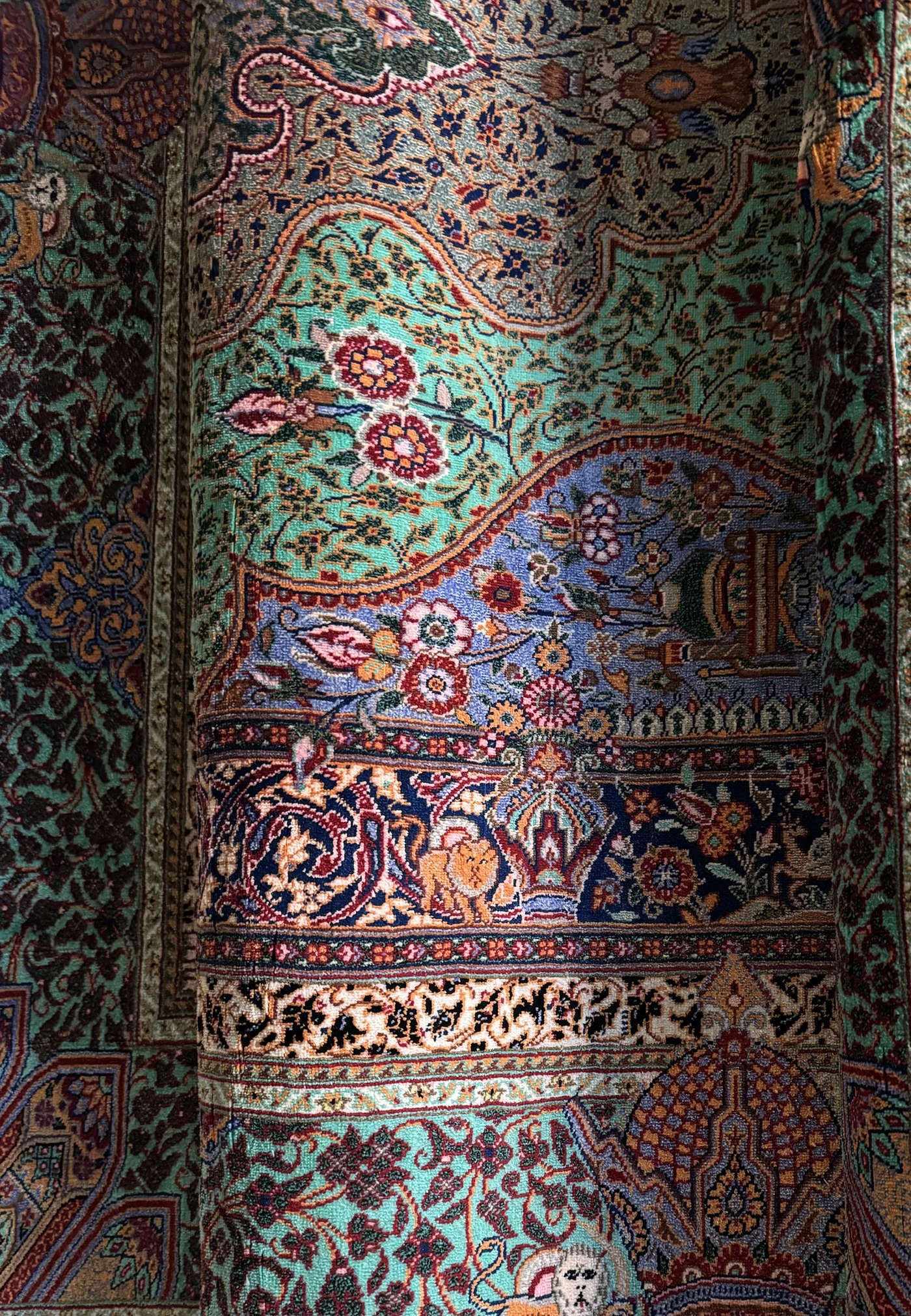
According to the oral history of Haj Hossein Kashizadeh, the palette expanded in stages, from five or six colours to seven, then nine, then twelve, then fifteen, and eventually beyond forty under the hands of the early designers. Dealer literature commonly describes modern Qom silks as using forty or more colours in a single piece.
The shift was not only a matter of taste. Early aniline dyes proved unstable and were eventually banned outright to protect the reputation of Persian carpets; from the late 1920s the more reliable chromium dyes came into use, and it was these, as much as any change in design, that made the wider palette possible as production grew.
This growth in colour and complexity raised the standing of the naghsheh-kesh, the designer. In the early years weavers often worked from memory or from a simple vagireh, a fragment of the pattern. In the silk era the designer became central. Pioneering figures such as Master Eshghi and Haj Hossein Jeddi, who ran a workshop and designed, laid the groundwork. They were followed by figures like Haj Hossein Bitarafan, whose family brand remains active in Qom today.
These designers moved away from strict Kashan emulation. They introduced elaborate pictorials such as hunting scenes and the tree of life, complex garden designs, and the dense, multi-layered floral fields that define modern Qom production.
Master Workshops and the Outsourcing Reality
By the late twentieth century Qom had a tier of master workshops, brands that sign their carpets and command premium prices on a reputation for flawless execution. Names such as Mir Mehdi, Rajabian, Masoumi and Jamshidi became known internationally. So did Ashkiyoun, the producer whose Jafarnejad silk brand HALI in 2016 placed among the most expensive carpets made anywhere, woven at up to thirteen by thirteen knots to the square centimetre; a panel of industry experts that year named Ashkiyoun the best Iranian producer. The largest such commissions are major undertakings, the work of many hands over several years on a single piece.
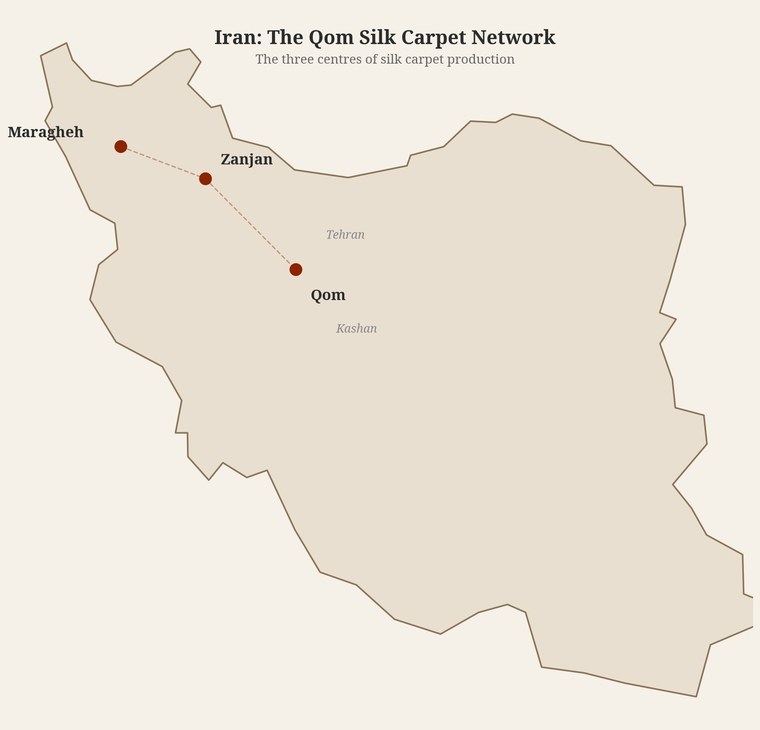
The success of the Qom name has also created a layered production reality. As demand grew and the cost of working in Qom city rose, weaving spread outward. Today a significant share of what is sold as “Qom silk” is woven in other provinces, using Qom designs and materials but lower-cost labour. Qom’s own producers describe the practice openly. The Ashkiyoun workshop, for one, has its rugs woven across eleven provinces of Iran, with every piece brought back to Qom for finishing and quality control. Many dealers distinguish three broad tiers. The first is premium Qom, woven in the city itself and often in named master workshops: the highest knot densities, the finest silk, the most exacting finish. Below it sits Zanjan production, woven in Zanjan province: generally average-to-good silk carpets in Qom designs, at slightly lower knot density or in less refined materials. The third tier is Maragheh, in East Azerbaijan, which the Iranian newspaper Hamshahri called “the silk carpet workshop of the country”: some fifteen thousand weavers there produce around thirty thousand square metres of silk carpet a year, much of it sold under the Qom name.
Dealers note that the price gap between a top-tier Qom-woven silk and a Maragheh-woven piece of the same design can be substantial. This is what makes provenance, documentation and the signature of a recognised master so important for a collector reading the modern market.
The Present
Qom’s standing is still considerable. The head of Iran’s National Carpet Center noted in 2018 that the province weaves around a fifth of all the country’s handwoven carpet exports, and that some ten thousand of Qom’s people work in the craft. As of 2025, the local producers’ and weavers’ union put the province’s output at about thirty-five thousand square metres of handwoven carpet a year, woven by some 3,600 registered weavers.
But the pressures are real. The same Centre acknowledged in 2018 that the United States, until then the destination for close to a third of Iran’s handwoven carpet exports, had been lost to sanctions, and that the search for new markets had begun. Closer to the loom, the fine skills the city was built on, warping, natural dyeing, the slow silk weaving that gives a Qom carpet its precision, are held now by an ageing generation, and the apprentices who once filled the workshops are not being replaced. A Qom silk can still be woven to a standard the founders would recognise; the uncertainty is no longer the skill but the succession.
In under a century Qom went from having almost no weaving of its own to a name that sells carpets around the world. It borrowed a craft, mastered the most demanding of materials, and carried colour and fineness further than the cities it had learned from. The harder task now is defending that name, in a market where much of what is sold as Qom was never woven there.