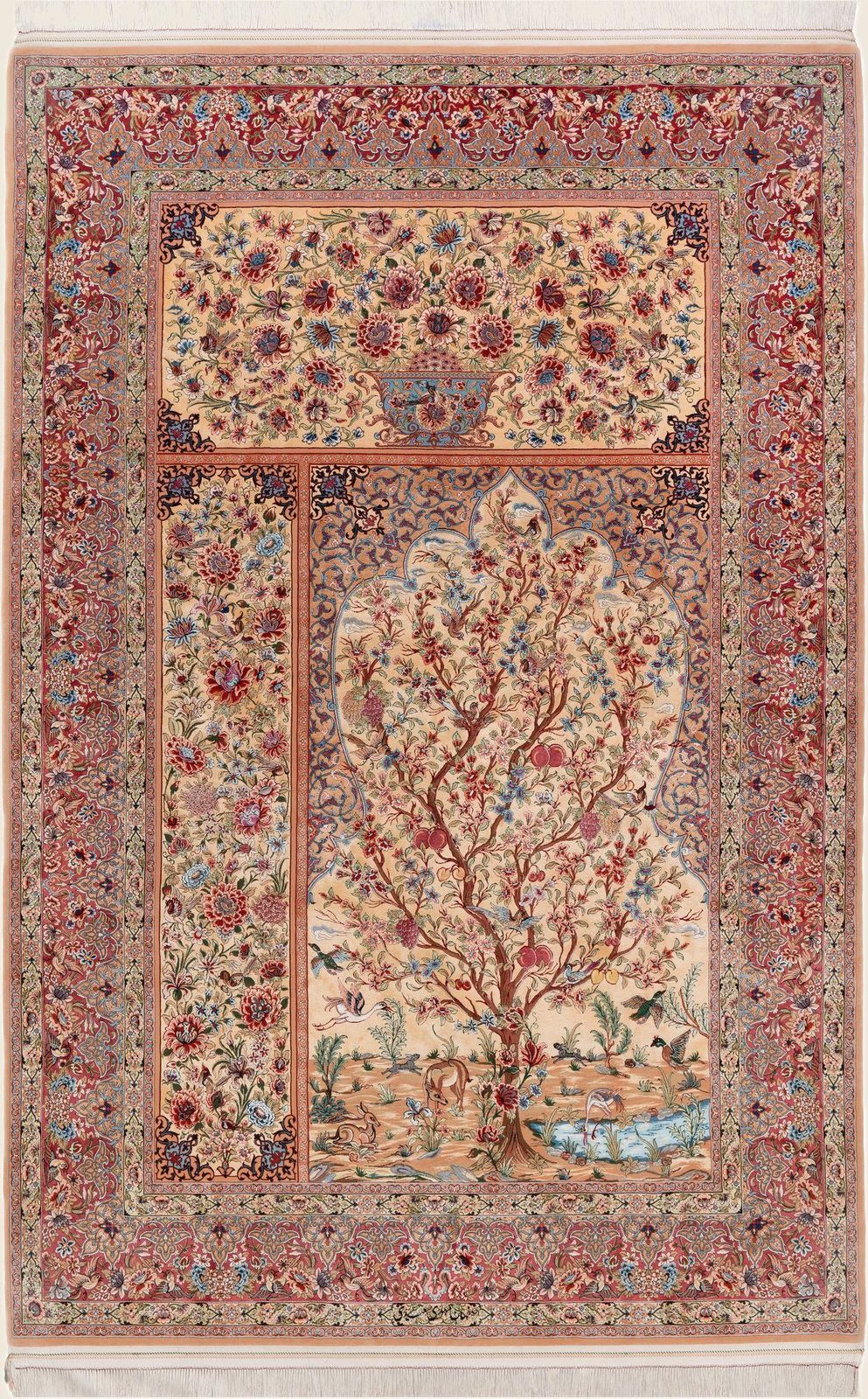
A finalist at the inaugural Qali-ye Fakher festival in 2022, this is an identical pair, two carpets by the contemporary Isfahan producer Mehdi Saeedi, each just over six square metres, woven at 73 raj on a silk foundation, signed in the lower border Isfahan Mehdi Saeedi. The field is mostly silk, with fine wool reserved for the plain margins and for parts of the drawing. The silk catches light where the wool stays matte, so the fields shimmer and shift as you move around the piece. The dyes are natural throughout.
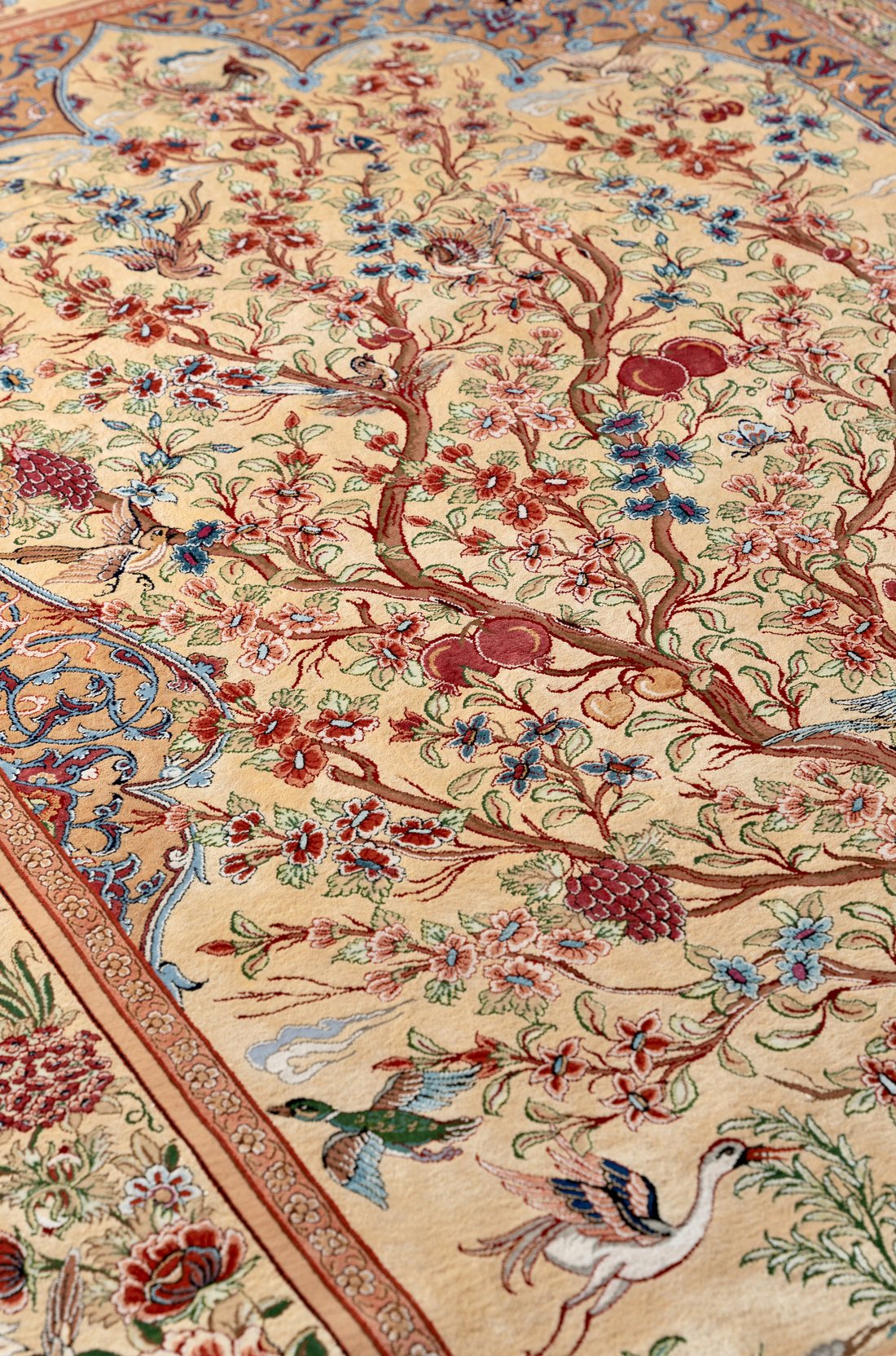
What sets the design apart is its construction in three distinct panels of unequal size, read together rather than separately. The largest, lower right, sits beneath a lobed mihrab (prayer-niche arch) and carries a Tree of Life on a cream field warmed to apricot: a single tree rising from a flowering ground, a crane stooping to drink at the water below, a deer grazing with its fawn at rest nearby, and behind them two hares bounding toward one another. The branches bear blossom and fruit and run with birds, a crane and a duck in flight, a crested pheasant, and small songbirds among the leaves. The fruits include pomegranate, grape, and cherry. A tall narrow panel down the left side holds a Gol o Bolbol (flower-and-nightingale), a composition Isfahan absorbed into its repertoire in Safavid times: dense without being crowded, large shah-abbasi palmettes and rosette blossoms among smaller iris and bud forms, with small birds among them. A band across the top holds a goldani (flowering vase): a small centred vessel from which a dense flowering field rises, alive with birds among the blossoms.
Each of these compositions, in the Isfahan tradition, would ordinarily occupy a carpet of its own, each a complete idea in itself. The unusual thing is that this work sets all three into one at once, and at deliberately unequal scale, so that they answer one another rather than compete: the tree rooted, the flower-and-bird panel dispersed, the vase contained, all held in a single field.
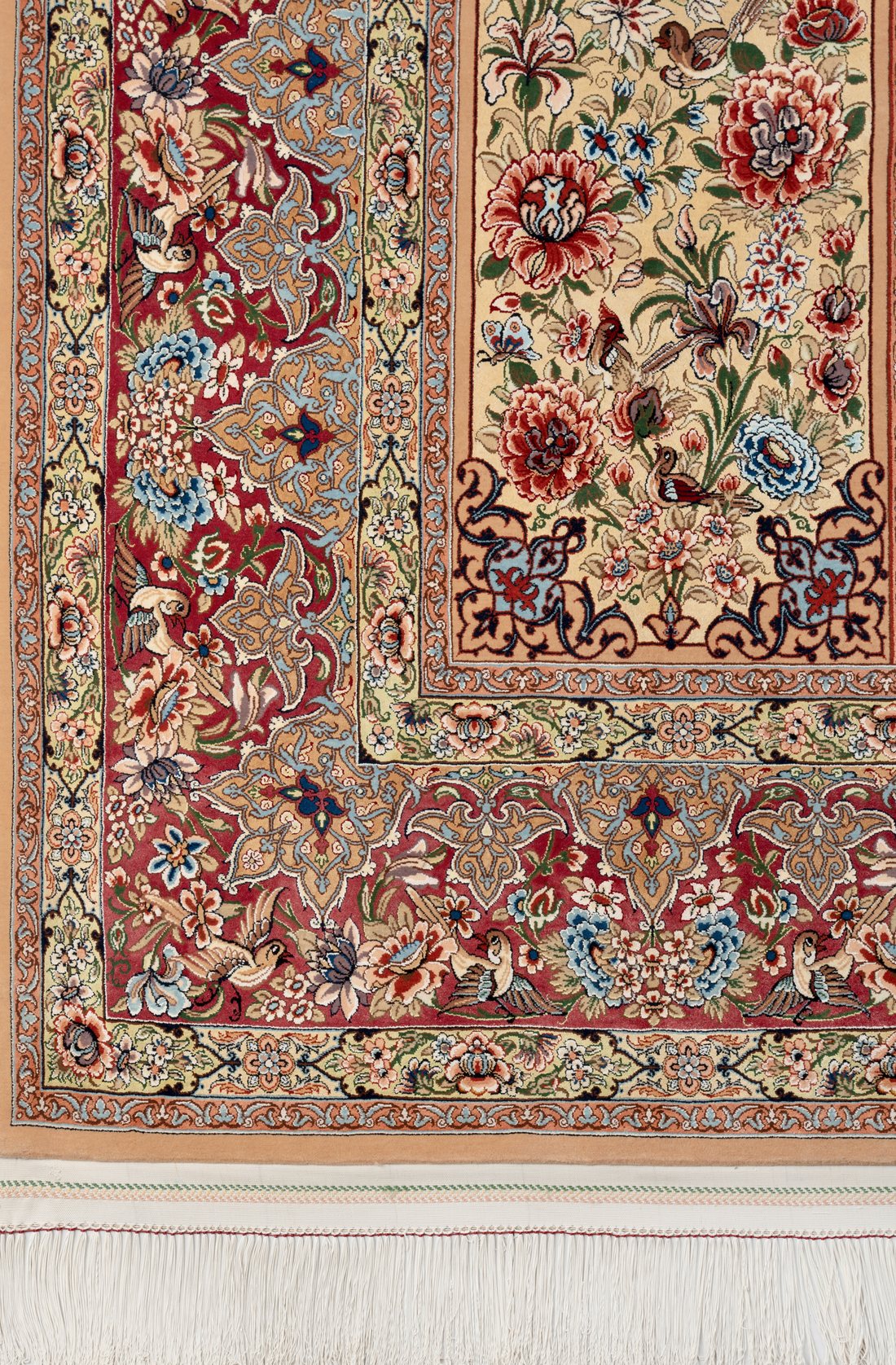
What makes the achievement easy to miss is that none of the vocabulary is new. The mihrab, the border with its red main band and pistachio-green minor band divided by guard stripes, all of it scrolling with palmettes and inhabited by small birds, the whole grammar of colour and motif belongs to the Isfahan of the last century. Only the assembly is unfamiliar, so the carpet does something new in wholly familiar terms: glanced at, it is an entirely classical Isfahan; studied, it turns out to be doing something the tradition does not.
The colour rewards the same scrutiny. The pair carries close to thirty distinct tones, yet nothing is loud. The reds are cochineal, the crimson insect dye, which yields a score of shades on its own and carries the flowers and border from pale pink and coral through to deep crimson. Madder takes up the warmer end, the dull red-browns and a soft quince-blossom drawn off at lower strength. Gold and straw come from weld, the blues and the leaf-greens from indigo, alone for the blues and over weld for the greens; the browns of the tree from walnut husk. Every tone is natural, drawn from root, insect, and leaf.
The finish holds one further surprise, nearly invisible at first. The pile sits at two heights, the silk standing fractionally proud of the wool, a low relief that catches the light. It does not read from across a room; it appears only when the eye comes close and the light rakes across the surface, and then the carpet seems to lift and settle as you move. It carries its finest work where only a close eye will ever find it.