
Most of the best-known Persian carpets ever woven do not survive in Iran. They survive in London and Los Angeles, in Vienna and Milan, in New York and Paris, scattered across five centuries by gift, by trade, by plunder, and at last by the auction room. The court art of Safavid Iran, made for shrines and palaces between about 1520 and 1650, now lies under museum glass thousands of miles from the looms that produced it. This is the story of where the survivors went. It is also an honest account of how little, in the end, can be proved about them.
Two carpets that can speak
Begin with the two that carry their own names and dates, because they are almost the only ones that do.
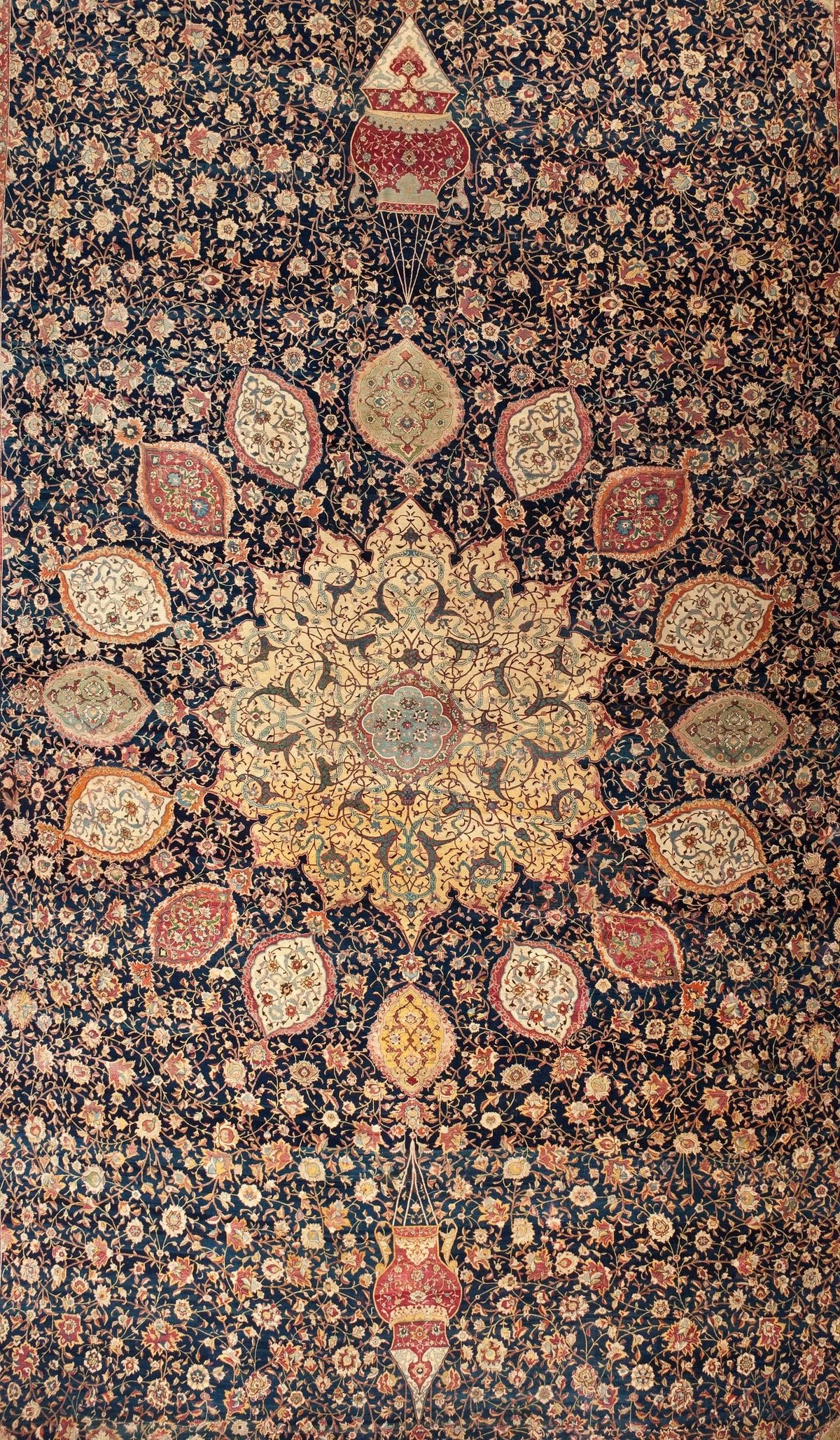
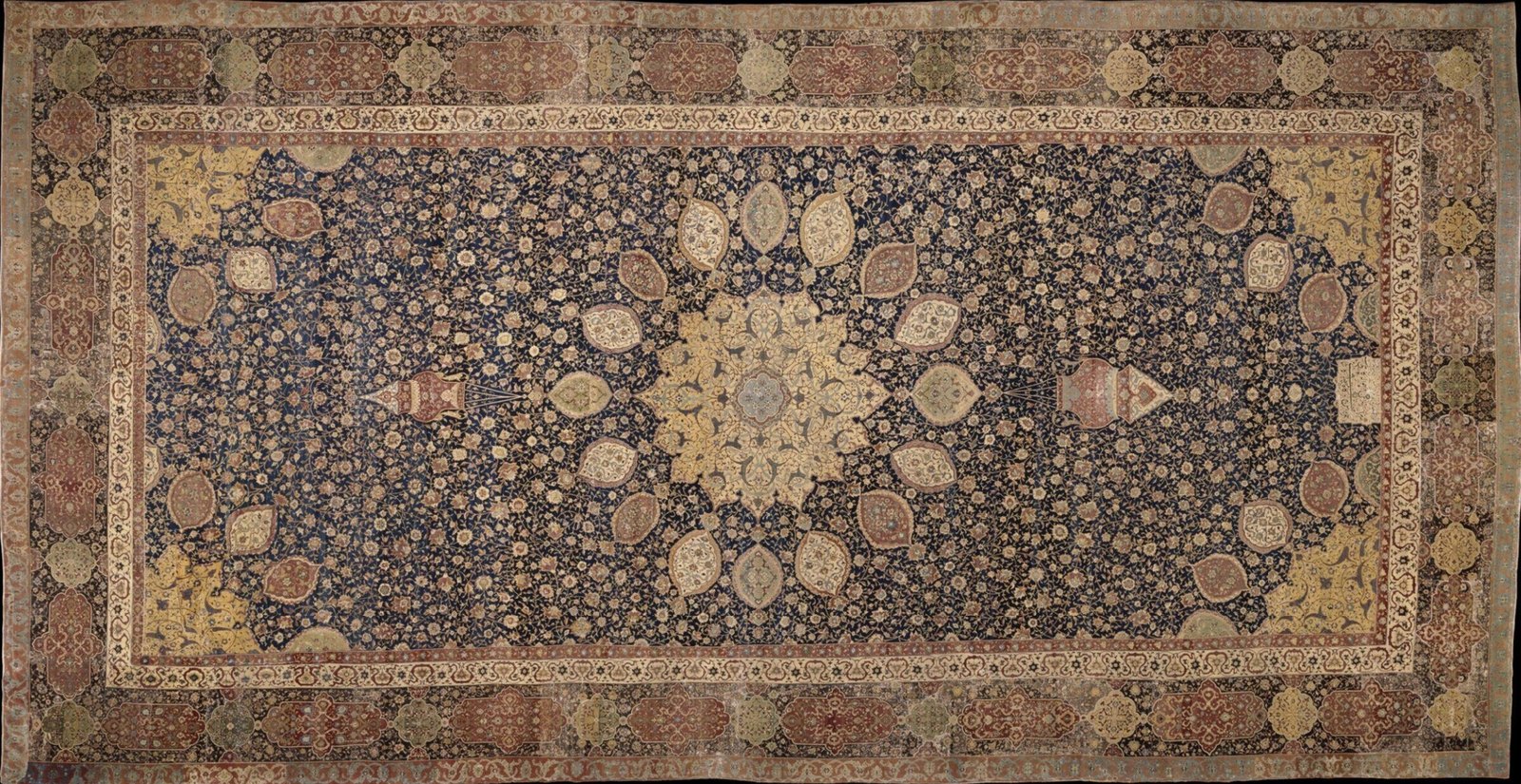
The first is the Ardabil, the most famous Persian carpet in the world, and in truth it is two carpets, not one. They were woven as a near-identical pair, dated by inscription to the year 946 of the Islamic calendar, which is 1539 or 1540, and signed by a man who called himself the slave of the threshold, Maqsud of Kashan. Above the signature runs a couplet of the poet Hafiz: except for thy threshold, there is no refuge for me in all the world. The pair are traditionally associated with the shrine of Shaikh Safi al-Din at Ardabil, the ancestral sanctuary of the Safavid dynasty, and were made under Shah Tahmasp. The museums that hold them describe Maqsud as the court official charged with the commission, the designer who set out the pattern and oversaw the work, rather than the man at the loom.
What happened to the pair afterward is the heart of this essay. By the late nineteenth century both had left Iran, sold out of the shrine after it fell into disrepair, and one was used to mend the other. The dealer who handled them, the firm of Ziegler and Company, restored a single complete carpet by cutting sections from its twin, so that the Ardabil now in the Victoria and Albert Museum is a reconstruction stitched from both, while the carpet now in Los Angeles was left short of its borders and part of its field, and later given a new outer border. The two were no longer twins because one had been quietly fed to the other. And the cutting was not only repair. A whole carpet sold for more than a damaged pair, and when the London museum bought its piece in 1893, on the advice of William Morris, it did not yet know a second Ardabil existed. The most famous Persian carpet in the world is, in part, a composite, assembled to present as flawless what had survived as two worn and incomplete things.
The other carpet that bears both a name and a date is the great hunting carpet in the Museo Poldi Pezzoli in Milan. It too is signed, by one Ghiyath al-Din Jami, whose verse in the central medallion declares the work brought to a goodly completion. It too is dated, though here the inscription is ambiguous: one digit of the date can be read two ways, giving either 1522 or 1542, and the museum records both while leaning, on grounds of style, toward the later reading. Even the fixed points, it turns out, are not entirely fixed.
After these two, the record goes quiet. Almost every other great Safavid carpet is anonymous and undated, placed in a particular decade and a particular city only by the slow argument of scholars comparing one weave to another. This is the central difficulty of the whole subject, and it is worth being plain about its cause. It is not that the court lacked any idea of a masterpiece; Safavid culture had its hierarchies of workshop and prestige, and prized fine weaving as it prized fine painting. It is that carpets lived in a different documentary world from the manuscript or the signed painting. The book was inscribed, dated, and kept; the carpet was laid on a floor and walked upon, and the apparatus of attribution that now surrounds these pieces was built later, abroad, by the people who collected them. The uncertainty about where they were born is itself a mark of how far they have travelled from the world that made them.
The court ateliers, dispersed
Once they left Iran, the court carpets followed different routes into the world, and the grandest of them went, as often as not, to the houses of emperors. Among the carpets most often proposed as the finest of all is a hunting carpet woven almost entirely in silk, now in the Museum of Applied Arts in Vienna, worked in silk pile and threads wrapped in gilded silver, with a small radiating medallion at its centre and, around the field, mounted hunters riding down their prey. Its border is unlike any other: a procession of winged figures with their hands raised. It was made for the court of Shah Tahmasp in the second quarter of the sixteenth century, probably at Kashan or Tabriz, and it passed into the imperial Habsburg collections, reaching the Vienna museum only in 1922. A second silk hunting carpet, of comparable fineness, is in the Museum of Fine Arts in Boston, having travelled there through the Torrigiani and Rothschild families. The three great hunting carpets, Milan, Vienna, and Boston, are constantly confused for one another in print, though they are easily told apart by their material: the Milan carpet has a wool pile on a cotton-and-silk foundation, the Vienna carpet silk and silver, the Boston carpet silk through and through.
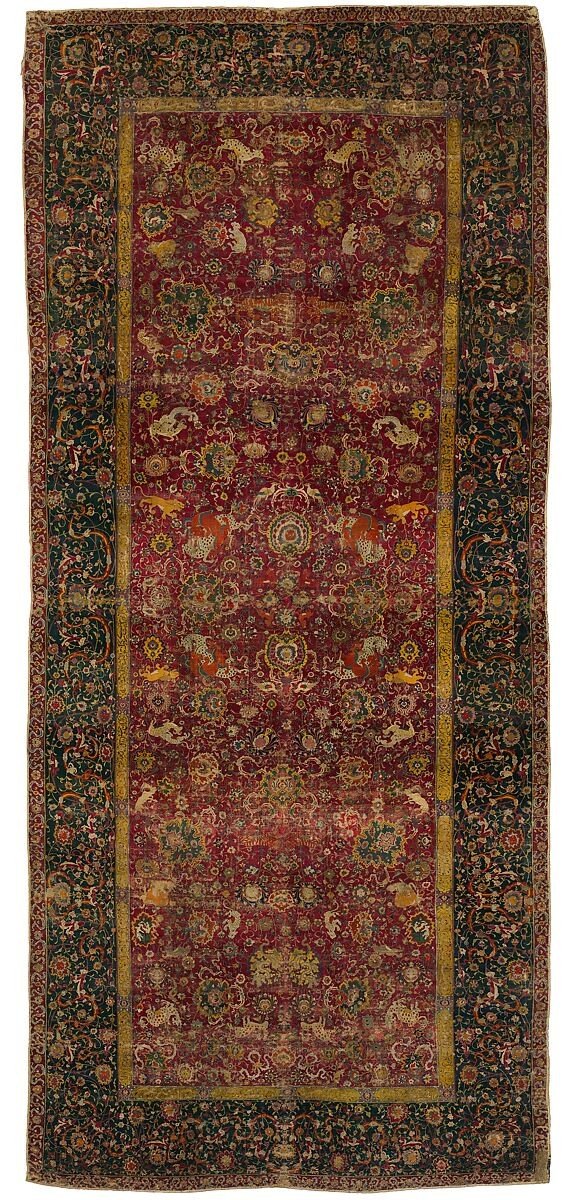
In New York, the Metropolitan Museum holds the carpet known as the Emperor’s, a court weaving of the later sixteenth century whose reddish field carries a forest of palmettes, cloud bands, and animals real and imagined, with a verse in the guard band likening a spring garden to paradise. Its very name records its passage into European hands: it once furnished the summer residence of the Habsburg emperors, and is remembered by the title its owners gave it rather than any it left Iran with. The fuller story told of it, that it passed through the hands of Peter the Great of Russia before reaching Austria, is tradition rather than documented fact, and is best left as tradition. The museum acquired it in 1943.
London holds, besides the Ardabil, the carpet called the Chelsea, named not for any place in Persia but for the King’s Road dealer from whom the museum bought it in 1890. Its origin is genuinely unknown; the museum offers Tabriz or Qazvin and commits to neither. Here too the carpet wears the name of its market and not its maker, which is true of more Safavid carpets than not: the names by which collectors know them generally record where they travelled, not where they were woven. The Chelsea is a smaller and more intimate thing than the Ardabil, a red field worked into a private garden of blossoming trees and grazing and fighting animals. Its silk foundation, its great fineness, and the dense menagerie crowded into its field place it among the supreme achievements of the early Safavid workshops.
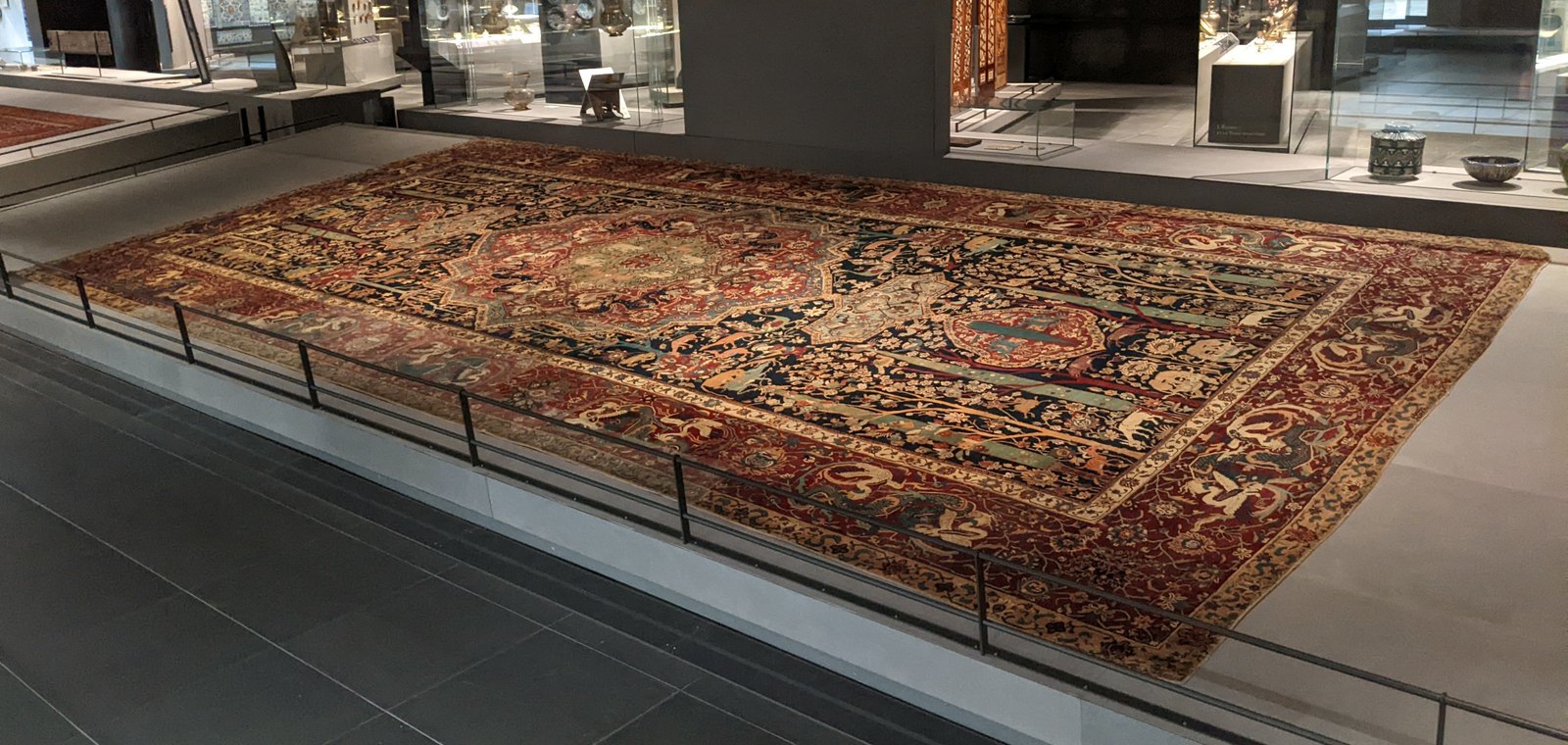
Paris holds the Mantes carpet in the Louvre, a vast medallion-and-hunting carpet of the second quarter of the sixteenth century, which spent its obscure years covering the floor of the collegiate church at Mantes, west of Paris, before its significance was understood. Across its field animals hunt and fight among brilliant floral forms, and one hunter carries a matchlock gun.
The carpets taken in war
Not every carpet left Iran by trade or gift. A whole group is named for the family that is said to have carried the first of them off a battlefield. The Sanguszko carpets, a small and closely related group from the Kerman region, are richly pictorial weavings, full of mounted figures, animal combats, and scenes that echo Persian manuscript painting, all bound together by a distinctive yellow ground at their centre. Their name is not Persian at all but Polish: a prince of the Sanguszko house is said to have taken the founding carpet as spoil in the wars against the Ottomans early in the seventeenth century, and the group has worn his name ever since. The story is tradition rather than record, but it makes the essay’s point exactly. The carpets are named for the soldier said to have seized one, not for anyone who wove them, and where in the Kerman region they were made remains a question scholars are still working out. The finest of them, a piece of extraordinary drawing, is now in the Miho Museum in Japan; one of the first to reach London entered the Victoria and Albert in 1883, again on William Morris’s recommendation, a full decade before the same museum acquired its Ardabil.
The phenomenon of the gift
Under Shah Abbas, around the turn of the seventeenth century, the court workshops turned out a flood of luxurious carpets in silk brocaded with gold and silver thread. Some furnished the palace; many were woven expressly to be given away, to ambassadors and foreign kings, as instruments of diplomacy. So many turned up in European collections that the nineteenth century invented a name for them on a false premise: when a group bearing Polish coats of arms appeared at the Paris exhibition of 1878, they were taken for Polish work and called Polonaise, and the misnomer stuck. They are not Polish. They are Safavid Persian silks, generally attributed to Isfahan and Kashan, dispersed deliberately by a court that understood a carpet as an argument made in wool and metal. Dozens survive, in Munich, in Berlin, in Stockholm, in Paris. They are less a set of individual masterpieces than a single sustained gesture of statecraft, repeated until such gifts stood in the treasuries and palace collections across Europe — and the name they are still catalogued under is a European error never corrected.
The verdict of the room
The dispersal has a modern coda, and it is a number. In June 2013, at Sotheby’s in New York, a small seventeenth-century vase carpet from Kerman, its field a scrolling vine of palmettes and long sickle-shaped leaves, sold for thirty-three million, seven hundred and sixty-five thousand dollars. It remains the highest price ever paid for any carpet at auction. The buyer was not named. After five centuries in which these carpets passed between dynasties and churches, collectors and museums, the last link in the chain is the same as so many of the earlier ones: a change of hands, and an owner no one can identify.
That is the shape of the whole history. These carpets were made to lie in particular rooms, for particular patrons, in particular cities, and almost none of them stayed. They left as gifts and as plunder and as merchandise, and in leaving they were renamed by their new owners, recatalogued by the market, and in the worst case recut as they passed through it. The record of how they travelled is often fuller than the record of how they were made. They can be seen today in London and Vienna and New York, among the most beautiful objects human hands have produced. What usually cannot be done, and the honest writer should not pretend otherwise, is to say precisely where they were born.
Sources
- Victoria and Albert Museum, collection records for the Ardabil Carpet (272-1893) and the Chelsea Carpet (589-1890).
- Armstrong, Dorothy. “Inventing the Ardabil Carpet: A Case Study in the Appropriation and Transformation of a Persian Artifact.” Iran 58:1 (2020), 110–130 — for the Ziegler reconstruction and its circumstances.
- Los Angeles County Museum of Art, record for its Ardabil Carpet (gift of J. Paul Getty).
- The Metropolitan Museum of Art, record for the Emperor’s Carpet (Rogers Fund, 1943; 43.121.1).
- Museo Poldi Pezzoli, Milan, record for the Hunting Carpet of Ghiyath al-Din Jami, including the disputed reading of its date.
- Museum für angewandte Kunst (MAK), Vienna, record for the silk Hunting Carpet (T 8336); Museum of Fine Arts, Boston, record for its silk hunting carpet, and M. S. Dimand, MFA Bulletin (1971).
- Musée du Louvre, Paris, record for the Mantes Carpet (OA 6610), dating it to the second quarter of the sixteenth century.
- HALI, The Magnificent Sanguszko Carpets, and the Genoa colloquium “Kerman Carpets of the Safavid Period (1501–1736),” 2022; Miho Museum, Japan, record for its Sanguszko carpet.
- Sotheby’s New York, sale of 5 June 2013, the Clark “Sickle-Leaf” vase carpet ($33,765,000).
- Encyclopaedia Iranica, “Carpets ix. Safavid Period,” for the contested attribution of weaving centres.
For almost every carpet named here, the city of origin — Tabriz, Kashan, Qazvin, Kerman, Isfahan — is proposed by scholars on the evidence of structure and design rather than settled by inscription; only the Ardabil pair and the Poldi Pezzoli hunting carpet carry both a date and a name. Museum accession records are relied on for ownership histories; attribution and dating follow the scholarly consensus current at the time of writing.