If Qom is the story of a craft invented and Isfahan the story of a craft revived, Tabriz is the story of a craft sold. The carpets of this north-western city are bound up, more than those of any other, with commerce: with merchants, export ledgers, foreign agents, and the European drawing rooms the looms learned to furnish. Yet Tabriz is also one of the oldest carpet cities of them all, the first seat of the royal Safavid workshops, and a place whose technical discipline survived centuries of political upheaval. Its history is the story of how a court tradition became the engine of the modern carpet trade, how a generation of twentieth-century masters elevated it to technical perfection, and what that transformation cost.
The First Court
Long before Isfahan, Tabriz was the Safavid capital. When Shah Ismail I founded the dynasty in 1501, he ruled from Tabriz, and it was here that the early royal carpet workshops were established. The period produced some of the supreme achievements of Islamic art. The most celebrated of them, the Ardabil Carpet, now the centrepiece of the Victoria and Albert Museum in London, is widely considered a masterpiece of sixteenth-century weaving. While scholars still debate whether it was woven in Tabriz, Kashan, or Ardabil itself, its intricate medallion-and-corner design is characteristic of the Tabriz school, and it remains a reference point for the city’s classical era.
During this period, Persian carpet design underwent a profound shift. The older, rigid geometric traditions gave way to flowing, curvilinear designs: intricate arabesques, floral scrolls, and complex medallions. Trade tradition often credits Tabriz weavers with inventing the curved line, but scholars attribute the shift more broadly to the influence of Safavid court painters and book illuminators, whose sophisticated drafts were translated onto looms across the major weaving centres.
When the Safavid capital moved east, first to Qazvin and then in 1598 to Isfahan, Tabriz lost its place at the centre of court patronage. Through the troubled centuries that followed, its looms, like those of most Persian cities, fell largely quiet.
The Merchant City
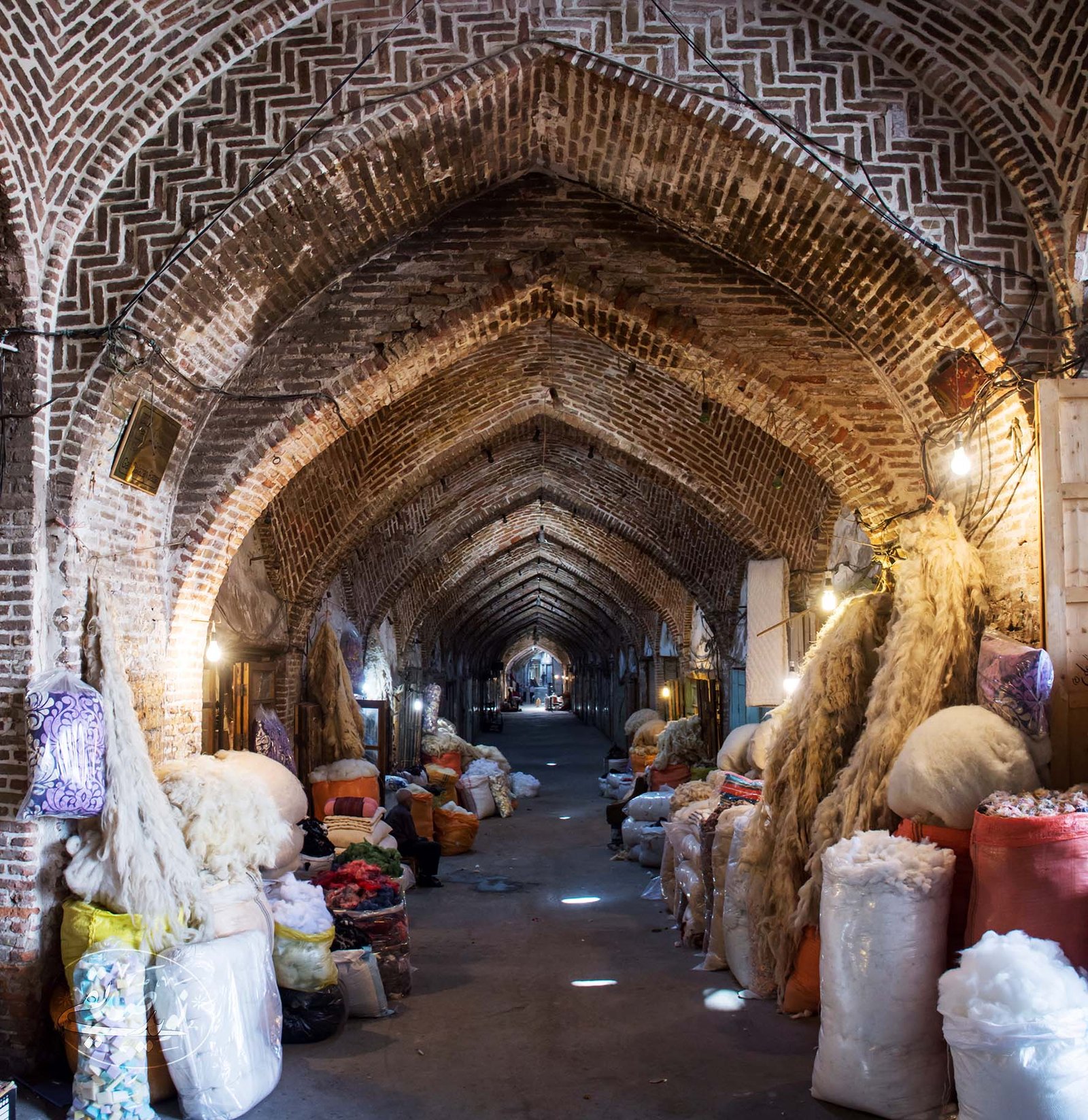
What set Tabriz apart was its geography. Of all the great Persian cities, it sat closest to Europe, serving as the natural gateway between Iran, the Caucasus, and the Ottoman lands. Its bazaar, today a UNESCO World Heritage Site and one of the largest covered markets in the world, had been a hub of Silk Road commerce since antiquity. Marco Polo, passing through around 1271 on his outward journey to China, described a great trading city drawing merchants from across the known world. When European demand for Oriental carpets began to stir in the nineteenth century, Tabriz was perfectly placed to answer it, and its merchants were the first to understand what was coming.
The turning point was the Vienna Exhibition of 1873, which set off a sudden appetite for Persian carpets among the rising European middle class. According to the Encyclopædia Iranica, dealers responded by buying up old carpets across Iran through agents in Tabriz, who quickly cleared the bazaars of their antique stock. When the old carpets ran out, the merchants of Tabriz did something new: they began weaving carpets specifically for export, designed to suit European taste. It was the birth of the modern commercial carpet, and Tabriz led it.
Crucially, this began as a Persian enterprise, not a foreign one. The export industry in Tabriz was first organised by native merchant families, among them the Dilmaqani, Sadaqiani, and Milani, who arranged contracts with local loom owners and reoriented the city’s production toward the new markets. Foreign capital followed: the Manchester firm of Ziegler & Co., which had established a trading agency in Tabriz in 1867, stationed carpet representatives there in the mid-1870s before industrialising production at Sultanabad. But the merchants of Tabriz had shown the way. The export figures tell the story plainly: carpets shipped from Tabriz through the Black Sea port of Trabzon rose from £28,000 in 1872 to £65,000 by 1879, and kept climbing.
The Nineteenth-Century Revival
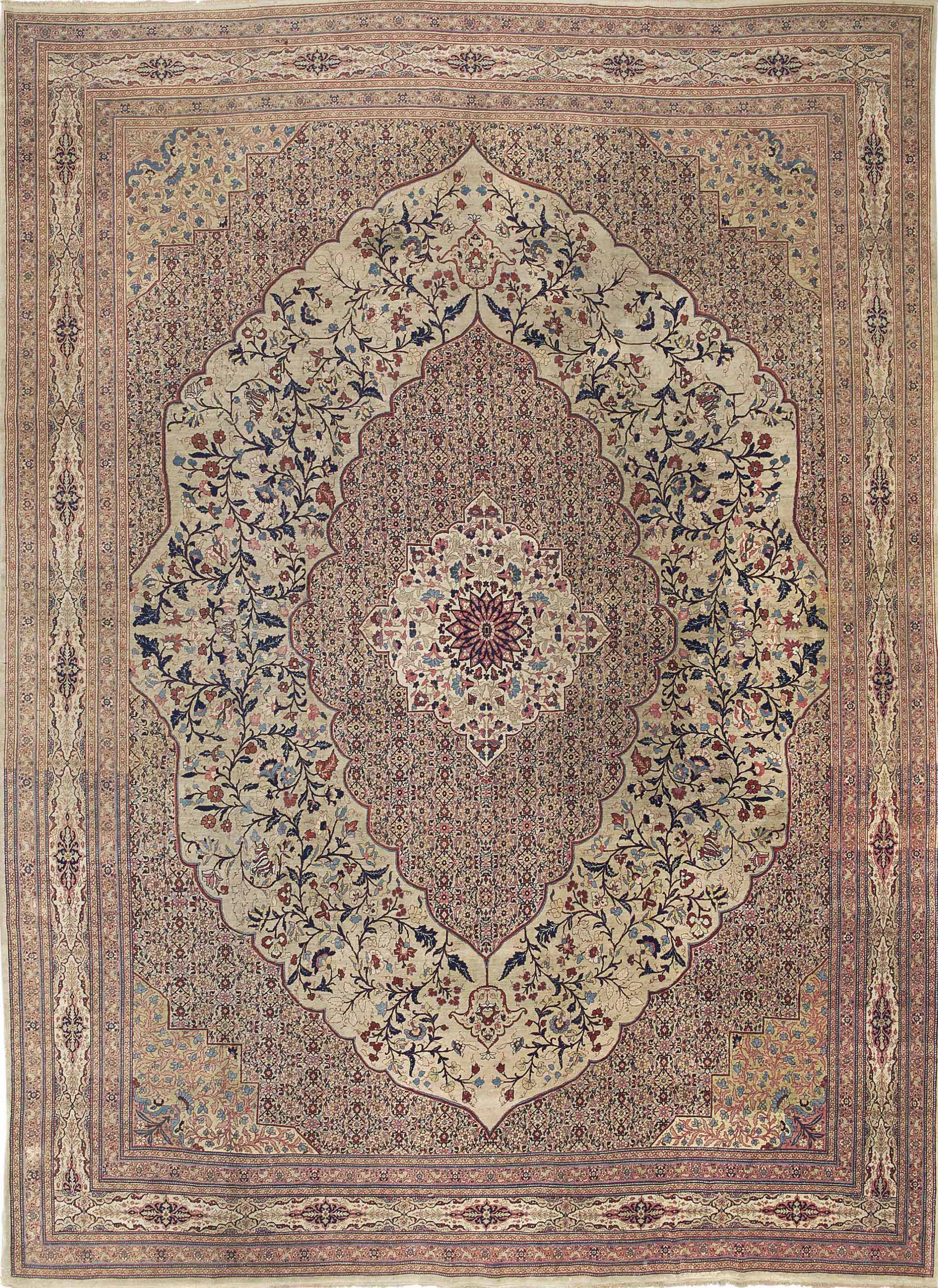
Commerce alone does not explain Tabriz, because the late nineteenth century also produced a remarkable artistic revival. Master weavers and designers set out to restore the city to its old eminence. Trade tradition remembers figures like Kurban Dai and Sheikh Safi, but the most celebrated of all was Hadji Jalili, who is traditionally said to have worked from the town of Marand.
Jalili’s carpets are unmistakable. Where classical Persian carpets often leaned on deep red and indigo, he worked in a deliberately muted register: light grounds, restrained earth tones, and cool blues deployed sparingly for accent rather than dominance. The effect was a carpet that breathed, open and luminous, suited to the Western interiors it was destined for without surrendering its Persian discipline. Today his work is regarded by many as a gold standard of the fine antique Persian carpet. He rarely signed them; a Jalili is recognised by its character rather than any signature.
The Twentieth-Century Masters
While the nineteenth-century revival laid the commercial groundwork, the twentieth century saw Tabriz elevate the craft to remarkable levels of technical precision. Unlike many other weaving centres, Tabriz weavers use both the symmetrical (Turkish) and asymmetrical (Persian) knots, working with a distinctive hooked knife that allows for fast and precise knotting. Quality in Tabriz is measured in raj, the number of knots across seven centimetres. Where bazaar goods might sit at twenty-four to thirty raj, the finest twentieth-century workshops pushed to fifty, sixty, and in exceptional cases beyond seventy raj, densities that allowed for extraordinary precision of drawing.
This era was defined by the establishment of highly organised workshops. In 1911 the German company Persische Teppich-Gesellschaft (PETAG) was founded in Berlin, with the explicit aim of restoring quality to a trade that mass commercialisation had degraded. Under the scholar Heinrich Jacoby, PETAG established a large workshop in Tabriz in the years that followed, using high-grade kork (fine, soft wool) and natural dyes to faithfully reproduce Safavid and Ottoman designs. Their carpets, identifiable by a çintamani motif signature (three balls above wavy lines), remain highly collectible.
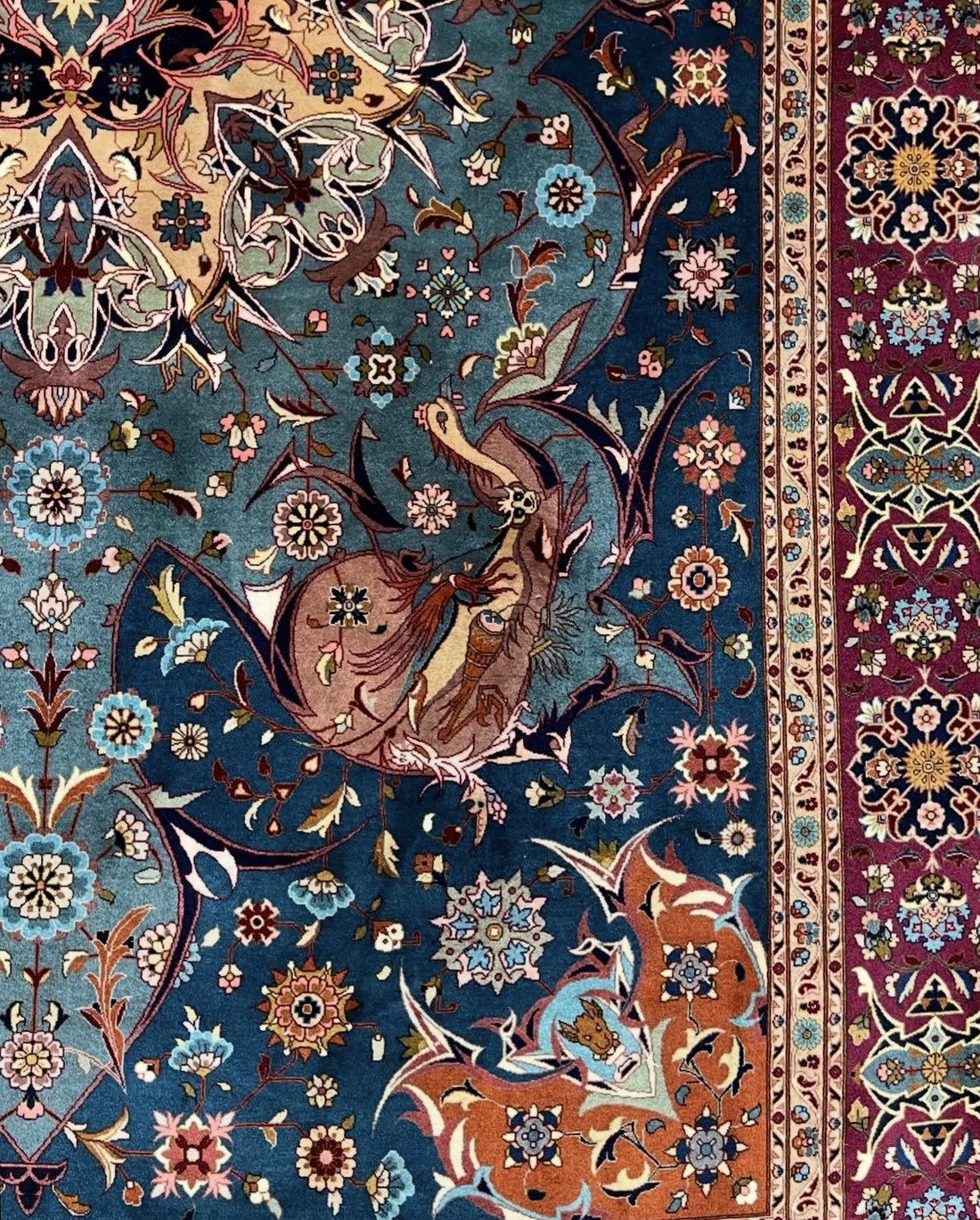
The Iranian masters followed suit, though here the record thins to what the trade remembers rather than what the archive confirms. The name most often repeated is Ahmad Emad, said to have trained under Mir Mosavvar Arjangi, whose workshop became a byword for fine, intricate medallion work. Another is Hassan Alabaf, who is credited with building a dynasty of some three hundred looms, a name carried on by his son Abbas Ali and, today, by a third generation. Around them the bazaar still recalls a generation of others: Naghi Shirfar for his custom designs, the draughtsman Mohammad Taghi Khiabani, and large producers such as Galibafi Nassadji and the Miri Brothers. What unites them, more than any documented biography, is the design vocabulary they worked in: from the ubiquitous mahi (fish, or herati) pattern to elaborate hunting scenes, kheshti (panel-grid) garden designs, and full pictorials.
The Reckoning
The commercial triumph carried a cost. Weaving for export meant weaving to demand, and not all of what the looms produced was fine. Critics complained that some commercial designs grew too regular and mechanical, and that cheap synthetic dyes from Europe displaced the vegetable dyes that had given the older carpets their depth. That tension, between the carpet as masterpiece and the carpet as commodity, was not unique to Tabriz, but Tabriz confronted it first and most sharply.
Today that tension has been overshadowed by an existential crisis. While Tabriz was honoured as a “World City of Carpet Weaving” by the World Crafts Council in 2015, the industry that built the city now faces collapse. The golden era is gone and exports have since fallen sharply from their peak.
In Tabriz, the human cost is heavy and concentrated on the loom. Recent reports describe over a thousand weaving workshops and hundreds of associated businesses facing bankruptcy. Hyperinflation has priced domestic buyers out of the market, while competitors from India, Pakistan, and Turkey take global market share with cheaper imitations. Material costs have climbed steeply, and each year the looms draw fewer young hands.
Yet Tabriz still weaves. In the Mozaffarieh, the grand covered hall of the bazaar, the trade goes on much as it has for generations: the finest pieces on the upper floors, the dyers and repairers below. Of all the Persian carpet cities, Tabriz was the one that always understood that a carpet is made to be sold, and that understanding may yet be its advantage. It has outlived the loss of empires and the redrawing of trade routes before. The merchants who built this city were never sentimental; they will not be sentimental now.