The history of a great weaving city is usually a story of continuity, or of a single fall and recovery. Tabriz passed its looms from one generation to the next; Kashan lost its craft and found it again. Isfahan’s story is different, and stranger. The city produced some of the supreme carpets of the Safavid court, then stopped almost entirely for two hundred years, then taught itself to weave again. The tightly knotted, silk-foundationed Isfahan carpets prized today are not the unbroken descendants of those Safavid masterpieces. They are the product of a deliberate revival, begun in the 1920s out of economic necessity and national ambition. This is the history of how a city remembered.
The Safavid Court
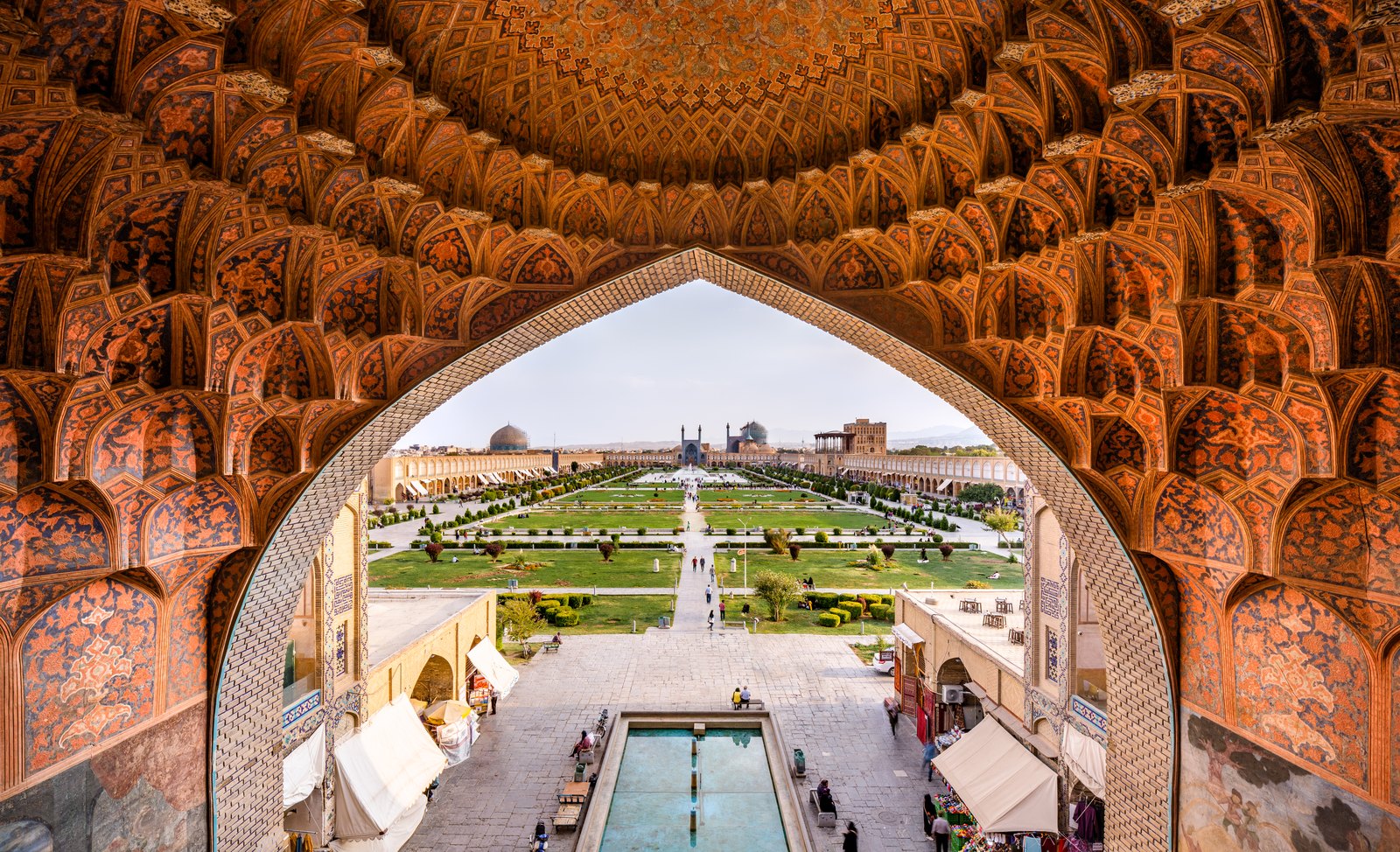
When Shah Abbas I moved the Safavid capital to Isfahan in 1006–07 AH (1598 CE), he established royal workshops around the great square at its centre, the Naqsh-e Jahan. Their carpets were not woven for the court alone: according to the Encyclopædia Iranica, the surplus was exported for sale in Europe and India, and the profits returned to the royal treasury. The Persian carpet had become a commercial commodity, and Isfahan was at its centre.
The most celebrated products of this period were the so-called Polonaise carpets, woven in silk, brocaded with silver and gold thread, and made for diplomatic gift and European export; a number were commissioned with the coats of arms of Polish and other European noble families, which is how the type later acquired its misleading name. Contemporary accounts record Istanbul dealers trading carpets out of Isfahan, and the trade reached as far as Mughal India. For roughly a century, Isfahan sat at the apex of the carpet world.
The Long Silence
It did not last. When Afghan forces sacked Isfahan in 1722, the Safavid order collapsed and the court workshops with it. The city’s carpet production fell away almost entirely. For close to two centuries Isfahan was a place of textiles and tilework, not carpets; the knowledge of how to weave a masterpiece either retreated to surrounding villages or was lost outright.
This silence is easy to misread. The decades after 1722 are conventionally cast as a dark age for the Persian carpet; the scholar Hadi Maktabi has argued that this is overstated: that weaving in fact continued through the eighteenth and early nineteenth centuries in regions such as Kurdistan and Khorasan, a vital precursor to the commercial revival that followed. Isfahan, though, was closer to the conventional picture: a great centre whose looms fell largely quiet while others carried on. When Western demand for Oriental carpets exploded in the later nineteenth century and cities like Tabriz, Sultanabad and Kerman industrialised to feed European and American buyers, the boom largely bypassed Isfahan.
The Revival of the 1920s
Isfahan’s return to weaving, beginning around 1300 Š./1921, was driven not by artistic ambition but by hardship. The Encyclopædia Iranica is explicit: Isfahan became a major carpet centre as a latecomer to the trade, and the development came out of economic pressure: natural disasters, drought, and the loss of older industries. At nearby Nain, the production of aba (the traditional cloak) had been discontinued, throwing skilled hands out of work. Many villages in the Isfahan area had retained their own weaving traditions, and these could be turned to commercial production.
Two larger forces met this local distress. The first was state-sponsored cultural nationalism: Reza Shah’s government set out to revive Iran’s Safavid and pre-Islamic heritage, and the carpet revival was bound up with a broader programme of restoring the city’s monuments. As the Iranica entry on Isfahan’s crafts records, the refurbishment of the Shaykh Lutfallah Mosque on the royal square in 1926, and the replication of its dome at a palace in Tehran, helped bring a whole generation of tile-makers, miniature painters, carvers and designers back into being, the same artistic ecosystem that carpet design drew on. The scholar Keelan Overton has traced how, between roughly 1920 and 1940, the restoration of Isfahan’s great Safavid monuments and the revival of its decorative arts proceeded together, reinventing Safavid aesthetics for a modern market.
The revival was not free of the era’s mistakes. To meet foreign demand, weavers across Persia had turned increasingly to cheap imported aniline dyes, which were notoriously unstable and faded badly; the Qajar government had tried to discourage them with a penal export duty as early as the 1900s, with weak enforcement. Isfahan’s revival, however, leaned harder on tradition than most. By the account of the Iran Carpet Company, vegetable dyes remained in common use in Isfahan well into the mid-century, and the city’s new masters made a point of refusing the shortcuts that had compromised production elsewhere. They also kept to wool where Qom would later commit to silk: the Isfahan signature became a pile of kork (fine, soft wool), prized for taking a high knot count, worked over a silk foundation, rather than the all-silk pile of a Qom. It is a distinction a practised eye still reads at a glance.
The Founding Masters
The modern Isfahan carpet was built by a small number of families who translated the city’s Safavid architectural heritage onto the loom.
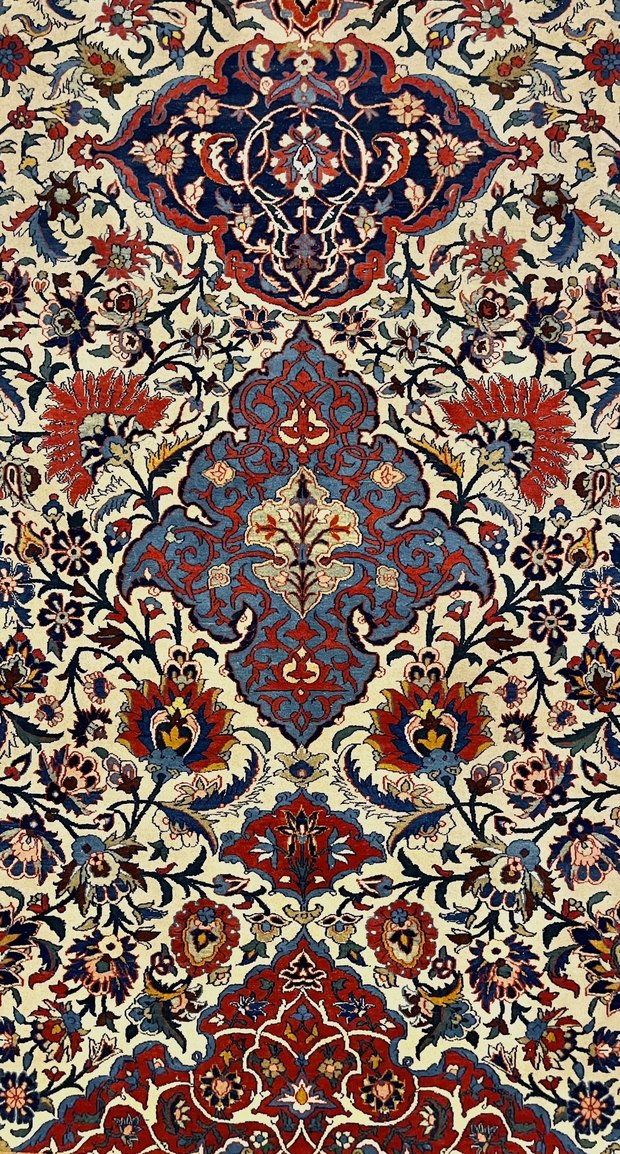
The foundational figure was Master AbdolSamad Khan, born around 1840. According to family accounts, he reverse-engineered older Persian textiles to recover lost weaving techniques; reportedly only three signed carpets by him survive, one of them preserved in a Tehran museum. His relatives carried the craft forward, most prominently the family that became known as the Shureshi, or “Rebel Family.” Its most celebrated figure, Abdul Rahim Shureshi (born 1869), raised Isfahan weaving to a new height and earned the personal admiration of the Shah. The Shureshi workshop became a byword for the best-of-type Isfahan carpet: exceptional knot density, classical motifs, and a discipline of finish that defined the city’s reputation.
Working in the same circle was Master Haj Mehdi Khan Safdarzadeh Haghighi, born in Isfahan around 1881 into a religious family, who apprenticed as a boy under both AbdolSamad and the Shureshi masters, to whom he was related. His contribution was institutional as much as artistic: responding to an invitation connected to the International Red Cross, he founded a weaving school on the Naqsh-e Jahan square, and he worked closely with Isfahan’s fine artists, including the miniaturist Mirza Agha Emami, to bring the discipline of the miniature into carpet design. Characteristically, the family maintains, he never wove his own name into his carpets; he let the work speak.
Seirafian: The Global Name
If Shureshi and Haghighi built the foundation, the Seirafian family built the brand that carried Isfahan’s name around the world. Haj Agha Reza Seirafian (1881–1974) came to carpets late, around 1939–40, after a career in banking, by one account, he entered the trade by completing two unfinished carpets he had taken in settlement of a debt. He then set about a relentless programme of quality: hiring only the finest designers and weavers, using only exceptional natural dyes, silk, and kork, and pushing knot densities far above the prevailing standard.
His son Haj Mohammad Seirafian is widely regarded as one of the greatest Persian carpet producers of the twentieth century. His most famous work, a carpet of roughly five by five metres, some twenty-five square metres, woven at an extraordinarily high knot count and years in the making, was presented to the United Nations in 2005, where it hangs at the headquarters in New York, its centre inscribed in gold thread with Sa’di’s Bani Adam: “All human beings are members of one frame.” The family’s standing was not only commercial: a Seirafian carpet was woven for Mohammad Reza Shah and dedicated to the Niavaran Palace. Across HALI, the leading scholarly carpet journal, the Seirafian name recurs as the reference point for fine modern Isfahan work.
The Designers: Emami and Archang
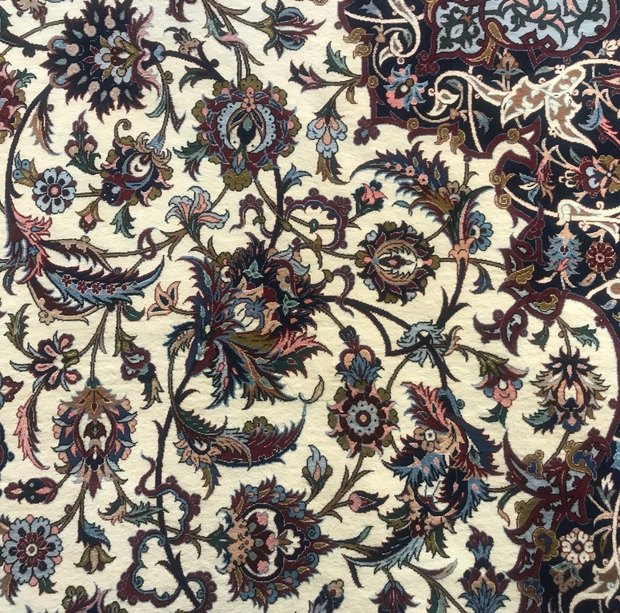
Isfahan’s technical brilliance demanded equally brilliant draftsmen, because the city’s carpets are, above all, drawn. Mirza Agha Emami (1881–1955) stands as the most influential of them, a miniaturist by training whose workshop taught a generation of Isfahan’s artists, among them the painter Mahmoud Farshchian, and whose hand brought the discipline of the miniature into carpet design. His most celebrated pupil in the carpet world was Ahmad Archang (1914–1990), the “islimi legend of Isfahan,” who learned the trade as a boy in the Haghighi and Shureshi workshops and went on to draw for the Seirafians; his medallion-and-arabesque compositions became the most copied designs the city produced. Archang and Haj Hossein Mosavvar-ol-Molki, the master of the pictorial hunting scene, were the two draftsmen most closely bound to the Seirafian name. HALI, the leading scholarly carpet journal, has placed the finest Isfahan drawing on a level with classical miniature painting, which is precisely the comparison these men earned.
A Craft Under Strain
Today the industry that those masters built faces an existential threat: the same national collapse traced in our history of Tabriz: exports down more than ninety percent from their peak since the 2018 reimposition of US sanctions. Isfahan has felt it as acutely as anywhere.
The human cost is heavy and concentrated on the loom. Of an estimated two million weavers across Iran, only about 273,000 carry any form of social-security insurance. In Isfahan, small workshops are closing; the head of the city’s handicrafts union reported in 2024 that licence-holders were giving up their permits to drive ride-share cars or work in food service. Material costs have climbed steeply while a weak domestic market keeps prices down, squeezing producers who pay dollar-linked prices for silk and earn rials at the sale. Fewer young people enter the trade each year.
The Safavid monarchs built Isfahan’s reputation; the masters of the 1920s revived it from silence. Whether the city’s weavers can survive the present collapse is an open question. The carpets will endure; they are made to. It is the hands that know how to make them that are now disappearing.