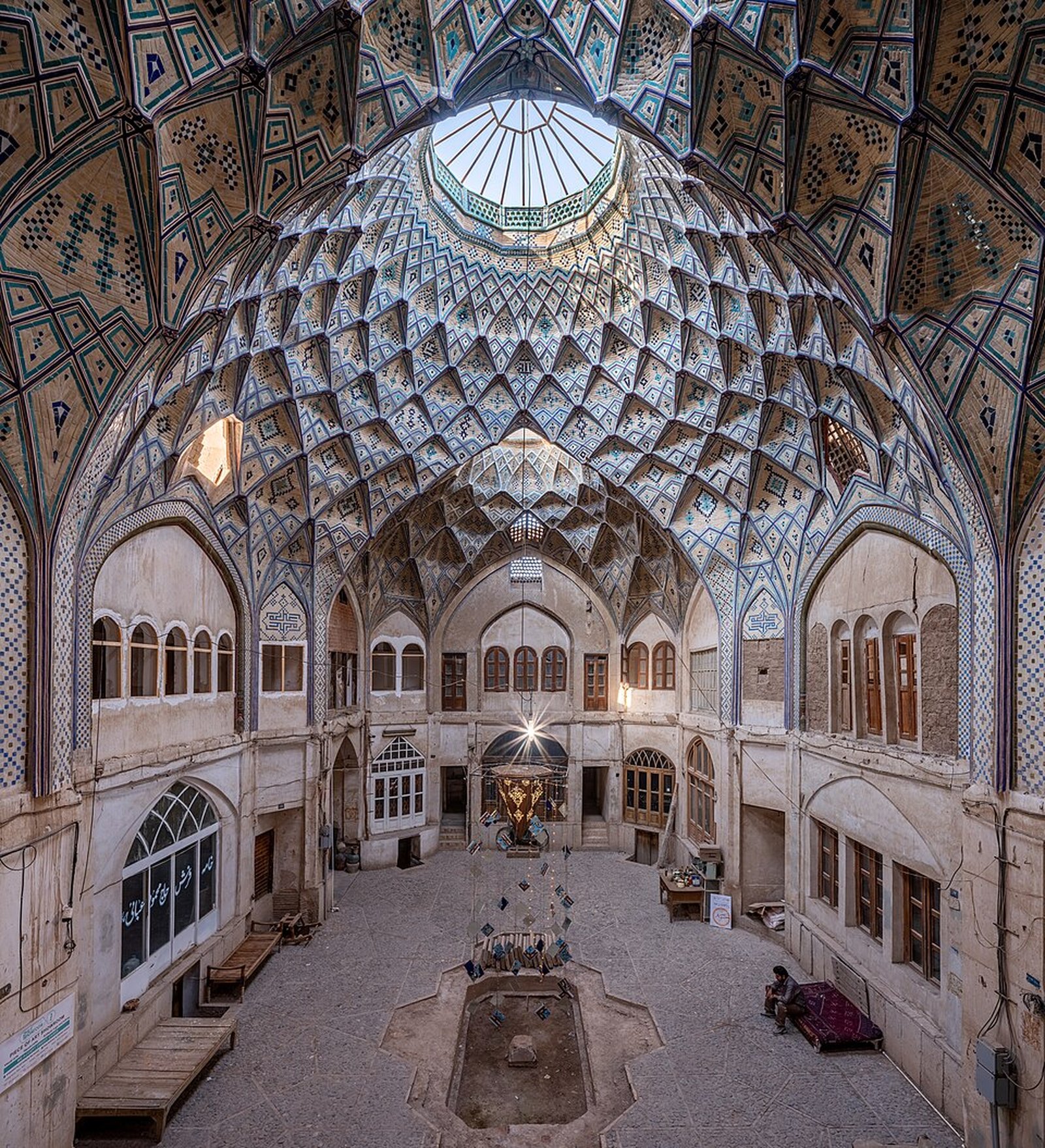
Most great Persian weaving centres tell a story of continuity. Kashan’s is a story of translation. The city did not build its artistic culture for the loom; it already possessed one of the deepest craft traditions in Persia, famous for its lustre ceramics, its velvet textiles, and the cultivation of roses. When Kashan turned its full attention to commercial carpet weaving in the late nineteenth century, it did not have to learn how to compose a masterpiece. It applied the discipline of the tile-maker and the silk-weaver to a new medium, and the result became, for much of the world, the very definition of the classical Persian carpet.
The Safavid Ecosystem
Kashan’s reputation was built long before the modern carpet boom. Under the Safavids it was a vital node in the Persian economy, sitting on the road between Isfahan and Tehran, and its wealth lay above all in silk. Private workshops in the city produced textiles for both the domestic market and export, and became especially renowned for their voided velvets and luxury lampas-woven silks. Its potters were as celebrated as its weavers: in the twelfth and thirteenth centuries Kashan was the undisputed centre of Islamic lustreware, the metallic-glazed tile and pottery that fired to a brilliant, reflective sheen. The association was so complete that the Persian word for tile, kashi, derives from the name of the city.
Carpet weaving lived within this ecosystem, though as a rarefied specialism. A small number of extraordinary all-silk carpets of the sixteenth and seventeenth centuries are credited to Kashan, among them pieces with elaborate hunting scenes that are counted among the finest carpets ever made; a number of the silk and metal-thread “Polonaise” carpets of the seventeenth century are also attributed to the city. The most famous carpet in the world, the Ardabil Carpet of 1539–40, now in the Victoria and Albert Museum, carries an inscription naming its maker as “the servant of the court, Maqsud Kashani,” Maqsud of Kashan, most likely the official who designed and oversaw the work rather than its weaver. The carpet’s place of weaving is itself debated among Tabriz, Kashan, Isfahan, and Kerman; what is certain is that the man entrusted with it carried the name of Kashan. Yet despite this royal pedigree, the city’s carpet production appears to have fallen dormant after the Afghan invasion of 1722 broke the Safavid order. For the next century and a half Kashan remained a place of textiles and rosewater, and its looms stayed quiet.
The Merchant’s Accident
The revival of Kashan weaving in the late nineteenth century has long been anchored by a founding legend. According to bazaar tradition, Hajji Mollah Mohammad Hassan Mohtasham was a prosperous Kashan textile merchant in the 1880s; when cheap machine-made European cloth began to threaten his trade, his young wife, who came from the weaving town of Sultanabad, introduced the craft of knotted carpet to his workshop. She is said to have woven her first carpet from imported merino wool that had been spun in Manchester, and the local merchants who saw it were enthusiastic enough to commission more. From that accident, the story goes, an industry was reborn.
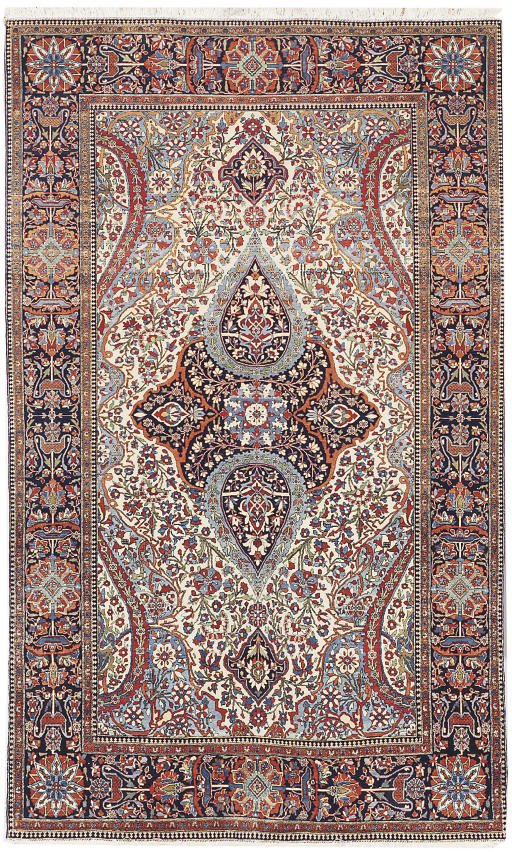
Recent scholarship has begun to move Mohtasham from legend toward documented fact. Research published in HALI, drawing on the Qajar-era papers of the Ghassem Ghani Collection at Yale, points to correspondence that records a Mullah Muhammad Mohtasham as a real Kashan figure, named to a local trade council, and to a previously little-known merchant who commissioned unsigned carpets in the Mohtasham manner. What was long treated as a romantic origin story is gaining an archival spine. The scale of what followed is not in doubt: by the revival’s start there were said to be only a handful of working looms in Kashan; by 1900 there were some fifteen hundred, and by the mid-twentieth century several thousand.
The carpets made under the Mohtasham name until the end of the nineteenth century remain the most prized of all antique Kashans. They are defined by a particular discipline: luminous lamb’s wool, exceptionally fine knotting, and a restrained palette of softened pastels, earth tones, and deep indigo, often built around a graceful teardrop medallion and finished with purple or ruby-red silk selvedge bindings. So completely did the name come to stand for quality that fine Kashan of the 1880–1914 period is generally called “Mohtasham” regardless of who actually wove it. A true Mohtasham today is treated less as a floor covering than as a portable work of art.
Manchester Wool and the Second Name
The revival rested on an unusual supply chain. Kashan sits at the edge of the Dasht-e Kavir, and the local desert wool is coarse and brittle, ill-suited to fine weaving. To achieve the velvet handle that intricate floral drawing demands, Kashan’s masters imported high-grade merino, spun mechanically in Manchester before it ever reached Persia. This “Manchester wool” defined the best Kashan production from roughly the 1880s into the 1930s; the machine-spun yarn was so consistent that weavers could tie extremely dense, even knots, and the resulting carpets were supple enough to hold the razor-sharp vines, palmettes, and rosettes that became the city’s signature.
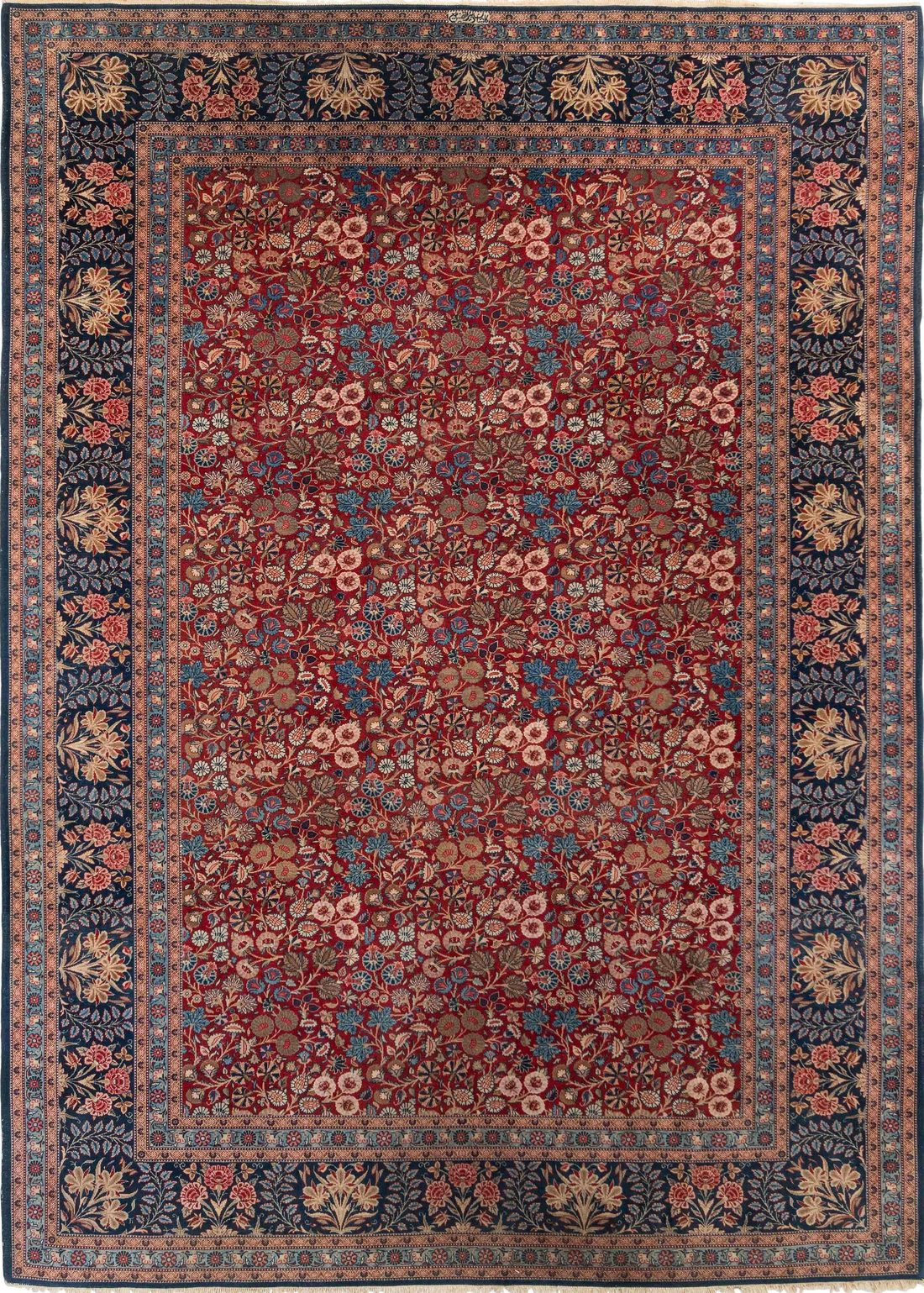
As the twentieth century went on, a second great name came to define Kashan: Dabir al-Sanaye. It was not a family name but a title, “registrar of the crafts,” conferred by Reza Shah on the designer Mahmoud (Mohammad) Dabir al-Sanaye, in recognition of the carpets woven to his designs for the royal palaces at Sa’dabad. Trained in the line of Mirza Ali Akbar, he was a painter of cartoons who also wove; his work is held today in the Iran Carpet Museum. But the name travelled further than the man. Some carpets carry the Dabir al-Sanaye signature woven into the border; many more, sold simply as “Dabir,” carry no signature at all and are attributed on the strength of weave, drawing, and wool alone, a reminder that in Kashan, as with Mohtasham before it, the most famous names are also the least precise.
The Discipline of the Loom
The construction of a Kashan carpet is famously rigorous. It is typically woven on a cotton foundation, which gives a stiff and durable architecture, using the asymmetrical Persian knot. The knotting is so precise that the back of a fine Kashan can be nearly as legible as the front. That precision was formally recognised in 2010, when UNESCO inscribed the traditional skills of carpet weaving in Kashan on its Representative List of the Intangible Cultural Heritage of Humanity. The listing notes how deeply the craft is embedded in the city: close to one in three residents works in carpet-making, more than two-thirds of the weavers are women, and the skills pass from mother to daughter, while men typically handle the designing, dyeing, shearing, and loom-building.
The colours of a traditional Kashan were as disciplined as its knotting. Before synthetic chrome dyes took hold in the 1930s, the city’s dyers worked from a deep vocabulary of natural materials: madder root for its reds, indigo for its midnight blues, and walnut husk, pomegranate rind, and vine leaf for the yellows and browns. The classic Kashan composition, a crimson field beneath a navy medallion, framed by ivory spandrels, became for the West the very picture of the “Oriental rug.”
The Inheritance
The industry that survived the fall of empires now faces the harder, national test traced in our history of Tabriz. In Kashan the strain is most visible in the bazaar, where small workshops are closing and master designers who once directed teams of assistants increasingly work alone. The economics have turned against the maker: raw silk and fine wool are paid for in foreign currency, while the finished carpet is sold at home for a depreciating rial. Inflation and a weak domestic market mean a weaver’s wage often cannot keep a family afloat, discouraging more and more people from taking up the loom each year.
Kashan’s history proves that a city can lose its craft and find it again. The artistic inheritance of the tile-maker and the silk-weaver was translated to the loom once already, and made to flower a second time. A city that has done that once knows something the others do not: that the loom can fall silent for a century and still be coaxed back. Kashan has been here before; and it is the only one of these cities that can say so.